<?xml version="1.0" encoding="utf-8"?><feed xmlns="http://www.w3.org/2005/Atom" ><generator uri="https://jekyllrb.com/" version="4.4.1">Jekyll</generator><link href="https://espositoandrea.github.io/feed.xml" rel="self" type="application/atom+xml" /><link href="https://espositoandrea.github.io/" rel="alternate" type="text/html" /><updated>2026-11-03T14:19:01+00:00</updated><id>https://espositoandrea.github.io/feed.xml</id><title type="html">Andrea Esposito</title><subtitle>Andrea Esposito is a postdoctoral researcher at Inria working on Human-Centred AI, Human-AI Interaction, and eXplainable AI. Publications, talks, teaching, and blog.</subtitle><author><name>Andrea Esposito</name></author><entry><title type="html">Frankfurt Through My Lens</title><link href="https://espositoandrea.github.io/blog/posts/2026/10/frankfurt-through-my-lens.html" rel="alternate" type="text/html" title="Frankfurt Through My Lens" /><published>2026-10-24T00:00:00+00:00</published><updated>2026-10-24T00:00:00+00:00</updated><id>https://espositoandrea.github.io/blog/posts/2026/10/frankfurt-through-my-lens</id><content type="html" xml:base="https://espositoandrea.github.io/blog/posts/2026/10/frankfurt-through-my-lens.html"><![CDATA[<p>Frankfurt has a reputation, and it is mostly a transit one. It is the airport
where you change planes, the skyline of banks that people call “Mainhattan,”<sup id="fnref:1"><a href="#fn:1" class="footnote" rel="footnote" role="doc-noteref">1</a></sup>
the home of the European Central Bank. It is a city that many people cross
without ever really arriving in it.</p>

<p>I did the opposite: I stayed. For the length of a research project at the
university, my work took me to Pfungstadt, a small town south of Frankfurt.<sup id="fnref:2"><a href="#fn:2" class="footnote" rel="footnote" role="doc-noteref">2</a></sup>
I chose to live in Frankfurt anyway and to commute.
I <a href="/blog/posts/2025/09/my-struggle-with-boredom-in-an-uninteresting-city.html">have written before</a>
about how quickly small towns bore me, and I wanted to come home, at the end of
the day, to a place that had something going on in it. Between conferences,
trips to see my girlfriend, and visits to my family, Frankfurt became the place
I kept returning to.</p>

<p>I did not go there to take photographs—still, the camera came along, as it
always does, and every so often the city gave me something I wanted to capture.
What follows is a selection: the frames I like most, shot on the days I felt
inspired. There may be others scattered around my hard drive, but these are the
ones I keep going back to.</p>

<h2 id="home">Home</h2>

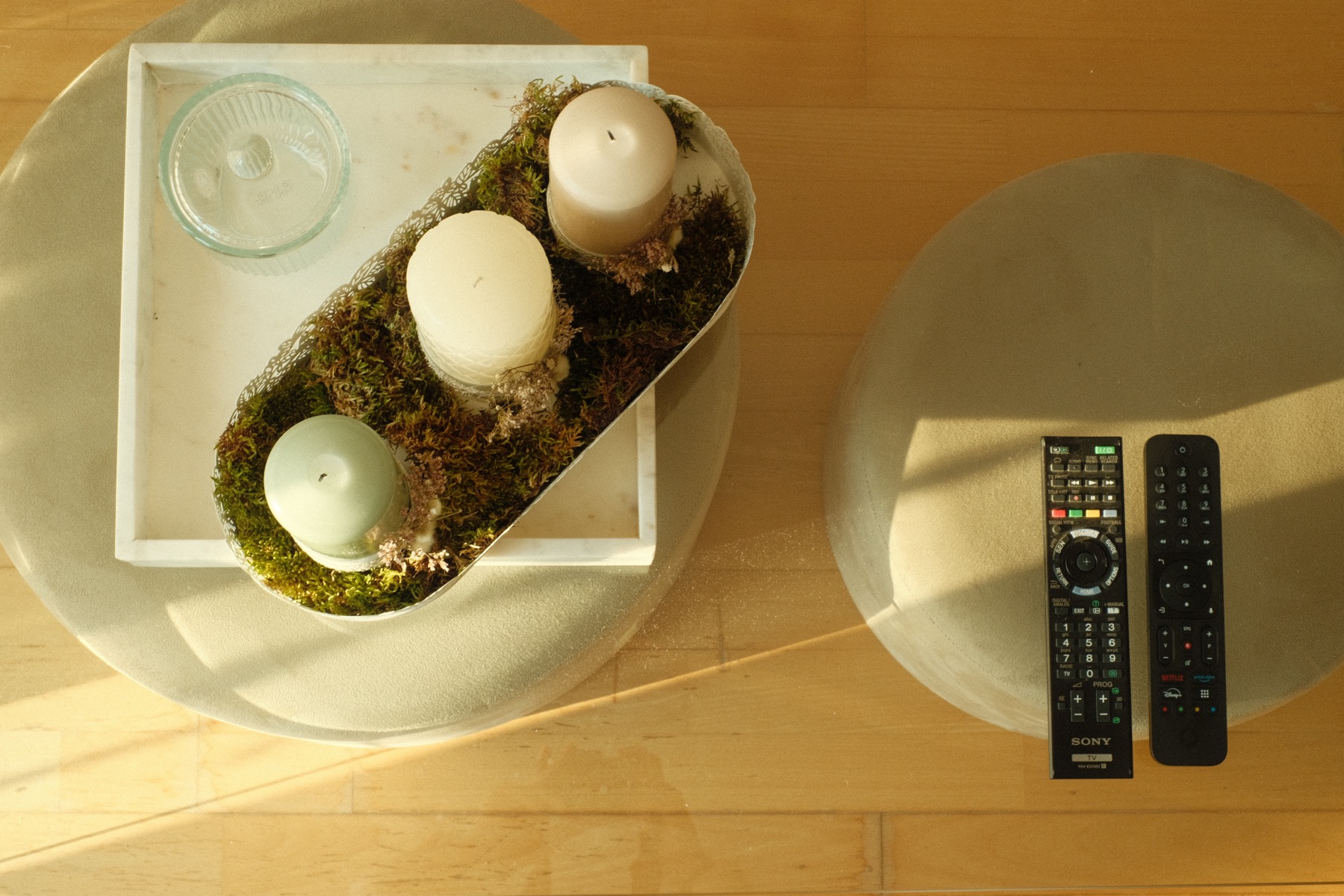
<p>Briefly after my arrival, I was immediately greeted by the stereotypical German weather of March. As such, part of my first days were spent at home. Needless to say, boredom was quickly taking a hold of me—especially since I come from the south of Italy and I am really used to enjoy an averagely-good weather. Until, suddenly, a shy sun was creeping past some clouds.</p>

<p>The late-afternoon light was crossing the floor of the living room in a way that was <em>beautiful</em>. I was extremely bored in a house that was new to me. So I took my camera and started searching for spots of light that catched my interest. There they were. A tray of candles in moss, some glass details, and some TV remotes.</p>

<figure class="post-photo post-photo-wide" id="photo-still-life" data-photo-id="still-life" itemscope="" itemtype="https://schema.org/Photograph">
    <a class="photo-link no-blank-icon" href="/assets/images/photography/2026-03-still-life-calmness-in-frankfurt.jpg" data-lightbox="">
        <img src="/assets/images/photography/2026-03-still-life-calmness-in-frankfurt.jpg" alt="A picture of some candles and a TV remote, with a warm tone" loading="lazy" decoding="async" itemprop="contentUrl" />
    </a>
    <figcaption class="post-photo-caption"><strong class="photo-title" itemprop="name">Still Life - Calmness in Frankfurt</strong>
        <span class="photo-meta"><time itemprop="dateCreated" datetime="2026-03-18">Mar 18, 2026</time><span itemprop="contentLocation">Frankfurt, Germany</span>
        </span><span class="photo-meta photo-exif">Fujifilm X-T30 II · XF35mmF1.4 R · 35mm · f/11 · 1/20s · ISO 800</span>
    </figcaption>
</figure>

<p>It may seem stupid, but those details spoke to me. It is the sort of things that tells you someone really <em>lives</em> here, and not only <em>sleeps</em> here. Outside, Frankfurt was quiet (I was staying in the perifery of Frankfurt, so traffice was much less than you could expect from such a city). This calm, warm, and cozy detail played into it. Every other photograph in this post exists, in a way, because I had somewhere quiet to come back to. This photo, for simple that it is, reminds me of appreciating the place I live in.</p>

<h2 id="from-above">From Above</h2>

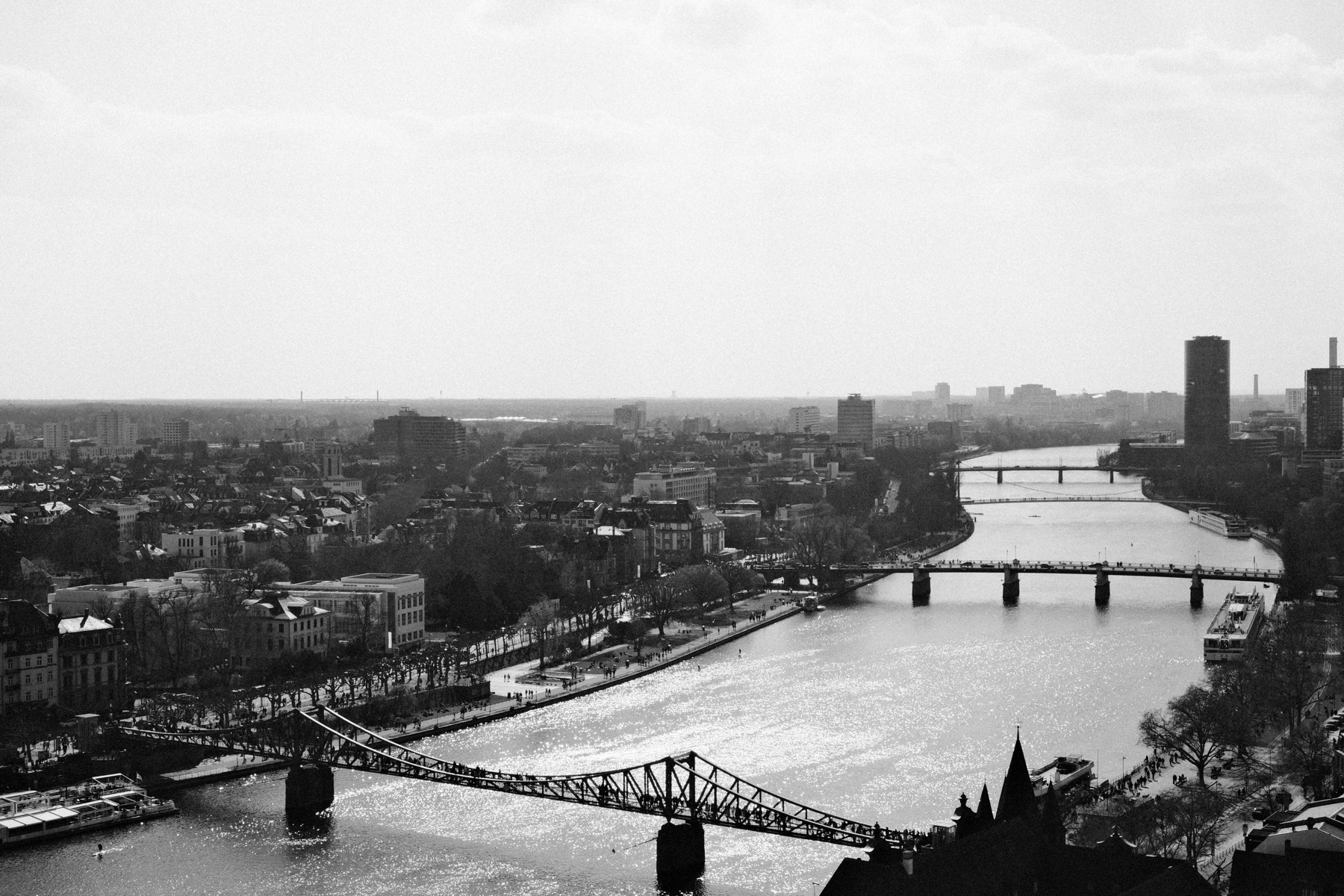
<p>Luckily, the weather got better. I went around in the city, going into the city center and enjoying the romantic old town. Obviously, I stopped at the Dom.  The Dom is one of the few places in the city where the old and the new fit in the same frame, and it lets you climb up to see it. From the top of its tower, I took two photographs a few minutes apart, standing more or lessin the same spot. I basically only had to turn around.</p>

<figure class="post-photo post-photo-wide" id="photo-skyline" data-photo-id="skyline" itemscope="" itemtype="https://schema.org/Photograph">
    <a class="photo-link no-blank-icon" href="/assets/images/photography/2026-03-frankfurt-skyline.jpg" data-lightbox="">
        <img src="/assets/images/photography/2026-03-frankfurt-skyline.jpg" alt="A picture of the famous skyline of Frankfurt" loading="lazy" decoding="async" itemprop="contentUrl" />
    </a>
    <figcaption class="post-photo-caption"><strong class="photo-title" itemprop="name">Frankfurt Skyline</strong>
        <span class="photo-meta"><time itemprop="dateCreated" datetime="2026-03-22">Mar 22, 2026</time><span itemprop="contentLocation">Frankfurt, Germany</span>
        </span><span class="photo-meta photo-exif">Fujifilm X-T30 II · XF35mmF1.4 R · 35mm · f/13 · 1/280s · ISO 320</span>
    </figcaption>
</figure>

<p>On one side, the towers. The skyline. I did not want to take yet another postcard-like shot of this same place, so I was looking at the crowd of shapes leaning on each other, leaning into the cacophony of the big economics buildings against the smaller residential ones.</p>

<figure class="post-photo post-photo-wide" id="photo-main" data-photo-id="main" itemscope="" itemtype="https://schema.org/Photograph">
    <a class="photo-link no-blank-icon" href="/assets/images/photography/2026-03-frankfurt-am-main.jpg" data-lightbox="">
        <img src="/assets/images/photography/2026-03-frankfurt-am-main.jpg" alt="A shot of the Main river in Frankfurt" loading="lazy" decoding="async" itemprop="contentUrl" />
    </a>
    <figcaption class="post-photo-caption"><strong class="photo-title" itemprop="name">Frankfurt am Main</strong>
        <span class="photo-meta"><time itemprop="dateCreated" datetime="2026-03-22">Mar 22, 2026</time><span itemprop="contentLocation">Frankfurt, Germany</span>
        </span><span class="photo-meta photo-exif">Fujifilm X-T30 II · XF35mmF1.4 R · 35mm · f/11 · 1/600s · ISO 320</span>
    </figcaption>
</figure>

<p>On the other side, the Main, the river that gives the city half of its name. The iron footbridge crosses it in the foreground, the other bridges fade into the haze, and the light turns the water into glitter.</p>

<p>Both shots are in black and white. I reach for black and white because I was respectively captured by the “brutalism” of concrete patterns and shapes, and by the contrast between land and bridges and water. I feel like colour would only have been noise in these.</p>

<h2 id="from-the-river">From the River</h2>

<p>I continued walking around, descending towards the river bank and walking for quite some time.</p>

<figure class="post-photo post-photo-wide" id="photo-ecb" data-photo-id="ecb" itemscope="" itemtype="https://schema.org/Photograph">
    <a class="photo-link no-blank-icon" href="/assets/images/photography/2026-03-european-central-bank-building.jpg" data-lightbox="">
        <img src="/assets/images/photography/2026-03-european-central-bank-building.jpg" alt="A shot of the European Central Bank building in Frankfurt" loading="lazy" decoding="async" itemprop="contentUrl" />
    </a>
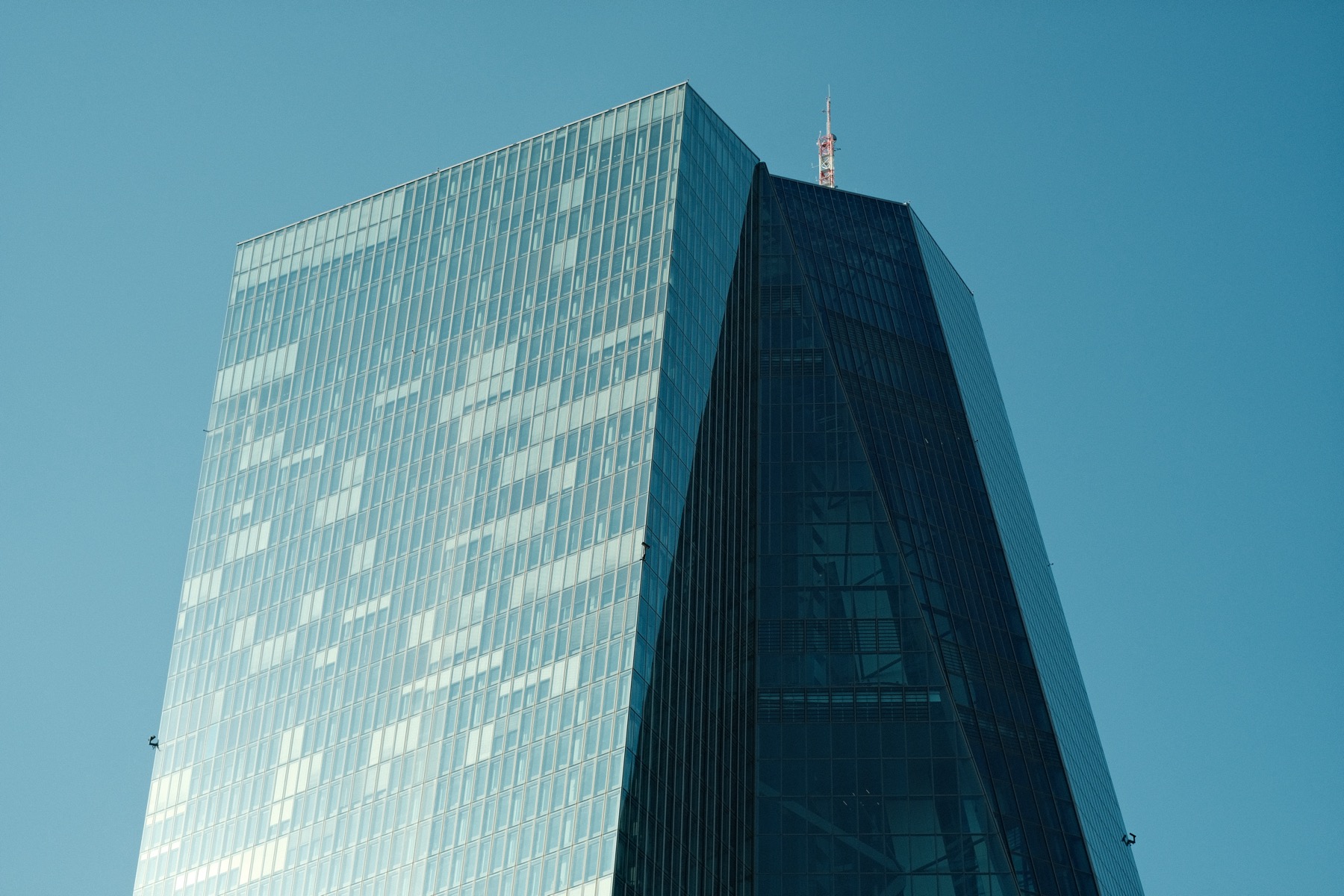
    <figcaption class="post-photo-caption"><strong class="photo-title" itemprop="name">European Central Bank Building</strong>
        <span class="photo-meta"><time itemprop="dateCreated" datetime="2026-03-19">Mar 19, 2026</time><span itemprop="contentLocation">Frankfurt, Germany</span>
        </span><span class="photo-meta photo-exif">Fujifilm X-T30 II · XF35mmF1.4 R · 35mm · f/4 · 1/1800s · ISO 320</span>
    </figcaption>
</figure>

<p>A great deal of Europe’s economic news is born inside this building. It is strange to stand in front of something you have only ever seen in headlines and discover that it is a tall, slightly twisted box of glass with a cheerful little antenna on top. I shot it in colour because the colour was the point: a teal sky, teal glass, and a dark wedge splitting the façade in two. The contrast was already built into the architecture, and I did not have to look for it.</p>

<figure class="post-photo post-photo-wide" id="photo-db-train" data-photo-id="db-train" itemscope="" itemtype="https://schema.org/Photograph">
    <a class="photo-link no-blank-icon" href="/assets/images/photography/2026-03-a-very-punctual-db-train.jpg" data-lightbox="">
        <img src="/assets/images/photography/2026-03-a-very-punctual-db-train.jpg" alt="A DeutcheBahn train passing through a bridge in Frankfurt" loading="lazy" decoding="async" itemprop="contentUrl" />
    </a>
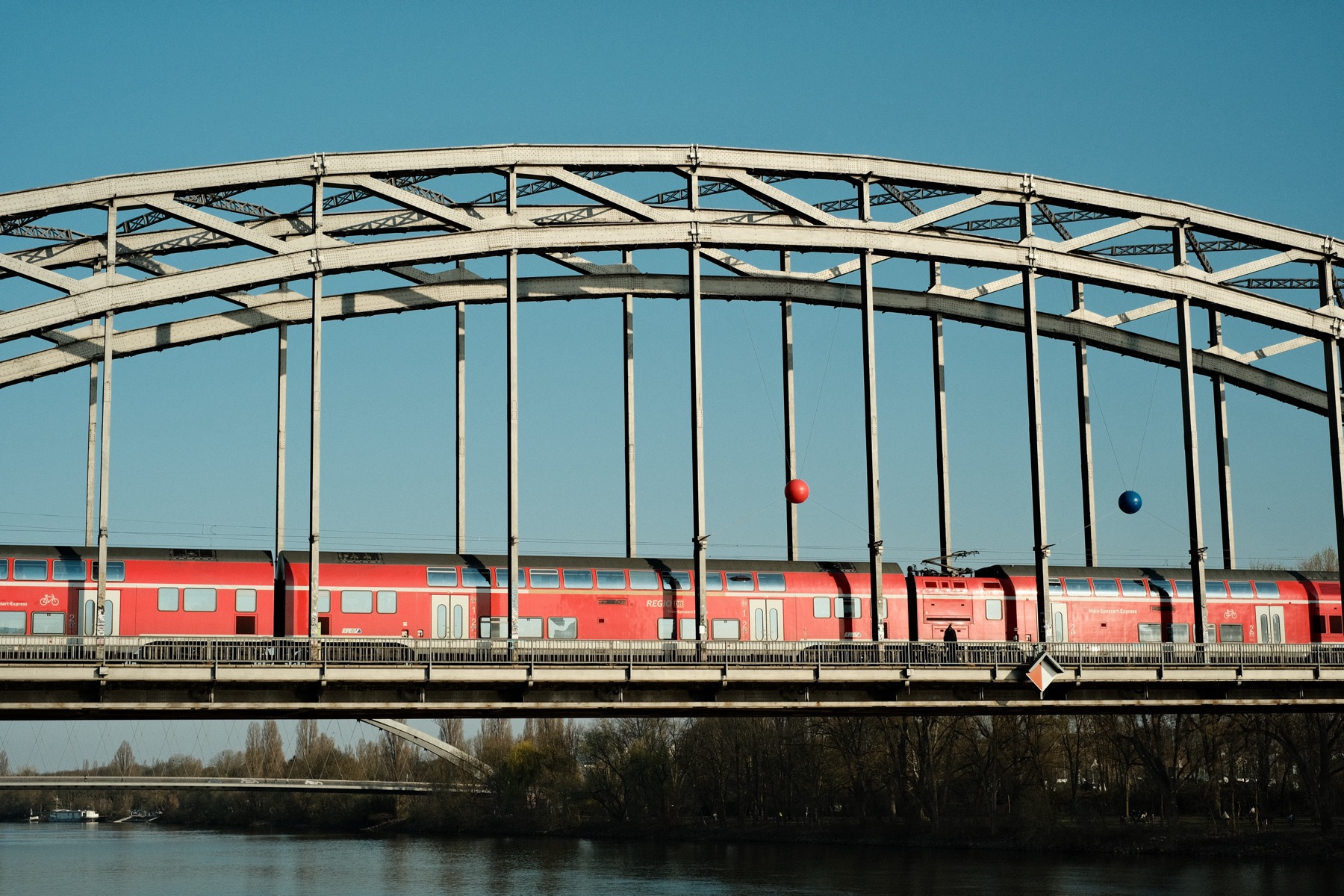
    <figcaption class="post-photo-caption"><strong class="photo-title" itemprop="name">A Very Punctual DB Train</strong>
        <span class="photo-meta"><time itemprop="dateCreated" datetime="2026-03-19">Mar 19, 2026</time><span itemprop="contentLocation">Frankfurt, Germany</span>
        </span><span class="photo-meta photo-exif">Fujifilm X-T30 II · XF35mmF1.4 R · 35mm · f/4 · 1/3800s · ISO 320</span>
    </figcaption>
</figure>

<p>While walking, I also noticed this bridge. I got curiously attracted by two baloons—or wathever they are—on its railings. I was wondering how they got there, and wether they serve a purpose or are there just because someone left them. I raised my camera, to capture them. And suddenly, a Deutsche Bahn train (I suppose an S-Bahn by the look of it) goes through the bridge. I said (sarcastically) to myself that <em>that</em> was perfect: the only time a Deutsche Bahn train is punctual<sup id="fnref:DB"><a href="#fn:DB" class="footnote" rel="footnote" role="doc-noteref">3</a></sup>, is for ruining a photo. But then I looked at it, and for some reason I liked the picture even more.</p>

<h2 id="underneath">Underneath</h2>

<p>Needless to say, during my stay there I took the S-Bahn some time. Admittedly, not as much as I expected (I also spent 6 months in Munich—there I really abused the underground stations and the Deutschland Ticket). One day, I was going to the airport to reach a conference. I got to the station, and I looked up.</p>

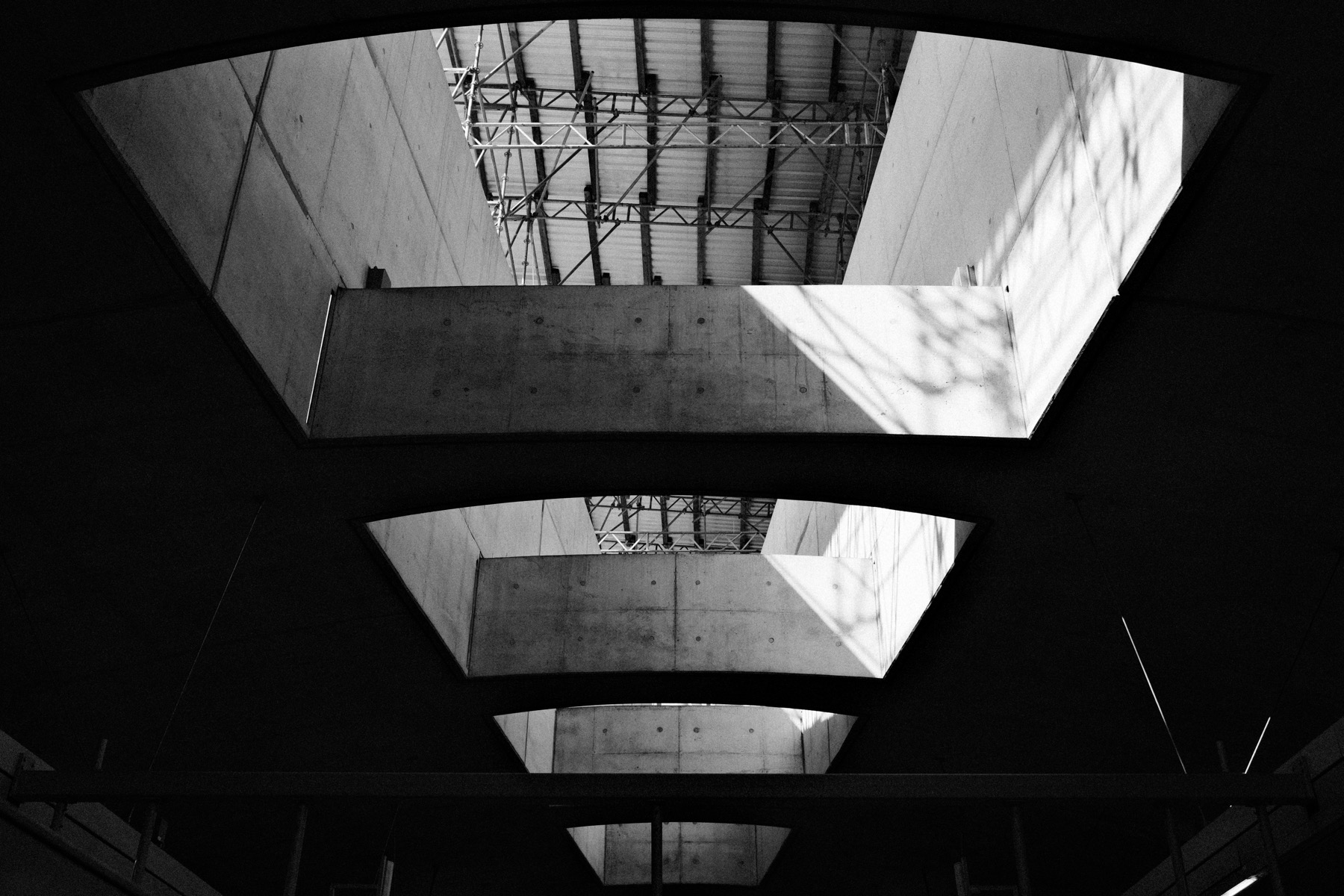
<figure class="post-photo post-photo-wide" id="photo-patterns" data-photo-id="patterns" itemscope="" itemtype="https://schema.org/Photograph">
    <a class="photo-link no-blank-icon" href="/assets/images/photography/2026-04-patterns-towards-darkness.jpg" data-lightbox="">
        <img src="/assets/images/photography/2026-04-patterns-towards-darkness.jpg" alt="A black-and-white picture of the concrete ceiling of an S-Bahn station in Frankfurt, with nested openings and scaffolding" loading="lazy" decoding="async" itemprop="contentUrl" />
    </a>
    <figcaption class="post-photo-caption"><strong class="photo-title" itemprop="name">Patterns Towards Darkness</strong>
        <span class="photo-meta"><time itemprop="dateCreated" datetime="2026-04-11">Apr 11, 2026</time><span itemprop="contentLocation">Frankfurt, Germany</span>
        </span><span class="photo-meta photo-exif">Fujifilm X-T30 II · XF23mmF2.8 R WR · 23mm · f/4 · 1/850s · ISO 320</span>
    </figcaption>
</figure>

<p>Here the brutalism rule applies in its purest form. Concrete openings sit inside one another like frames within frames, each smaller than the last, until they dissolve into black. Scaffolding shows through the first one, and a patch of light and shadow falls on the wall. Stations are designed to be walked through quickly, with your eyes on a screen or a timetable. I am glad I was early enough to allow myself to loop up.</p>

<h2 id="after-dark">After Dark</h2>

<p>I will end where the day ends.</p>

<figure class="post-photo post-photo-wide" id="photo-hauptwache" data-photo-id="hauptwache" itemscope="" itemtype="https://schema.org/Photograph">
    <a class="photo-link no-blank-icon" href="/assets/images/photography/2026-09-hauptwache.jpg" data-lightbox="">
        <img src="/assets/images/photography/2026-09-hauptwache.jpg" alt="A picture of the Hauptwache station in Frankfurt, with a couple of people getting out" loading="lazy" decoding="async" itemprop="contentUrl" />
    </a>
    <figcaption class="post-photo-caption"><strong class="photo-title" itemprop="name">Hauptwache</strong>
        <span class="photo-meta"><time itemprop="dateCreated" datetime="2026-09-11">Sep 11, 2026</time><span itemprop="contentLocation">Frankfurt, Germany</span>
        </span><span class="photo-meta photo-exif">Fujifilm X-T30 II · XF23mmF2.8 R WR · 23mm · f/2.8 · 1/100s · ISO 400</span>
    </figcaption>
</figure>

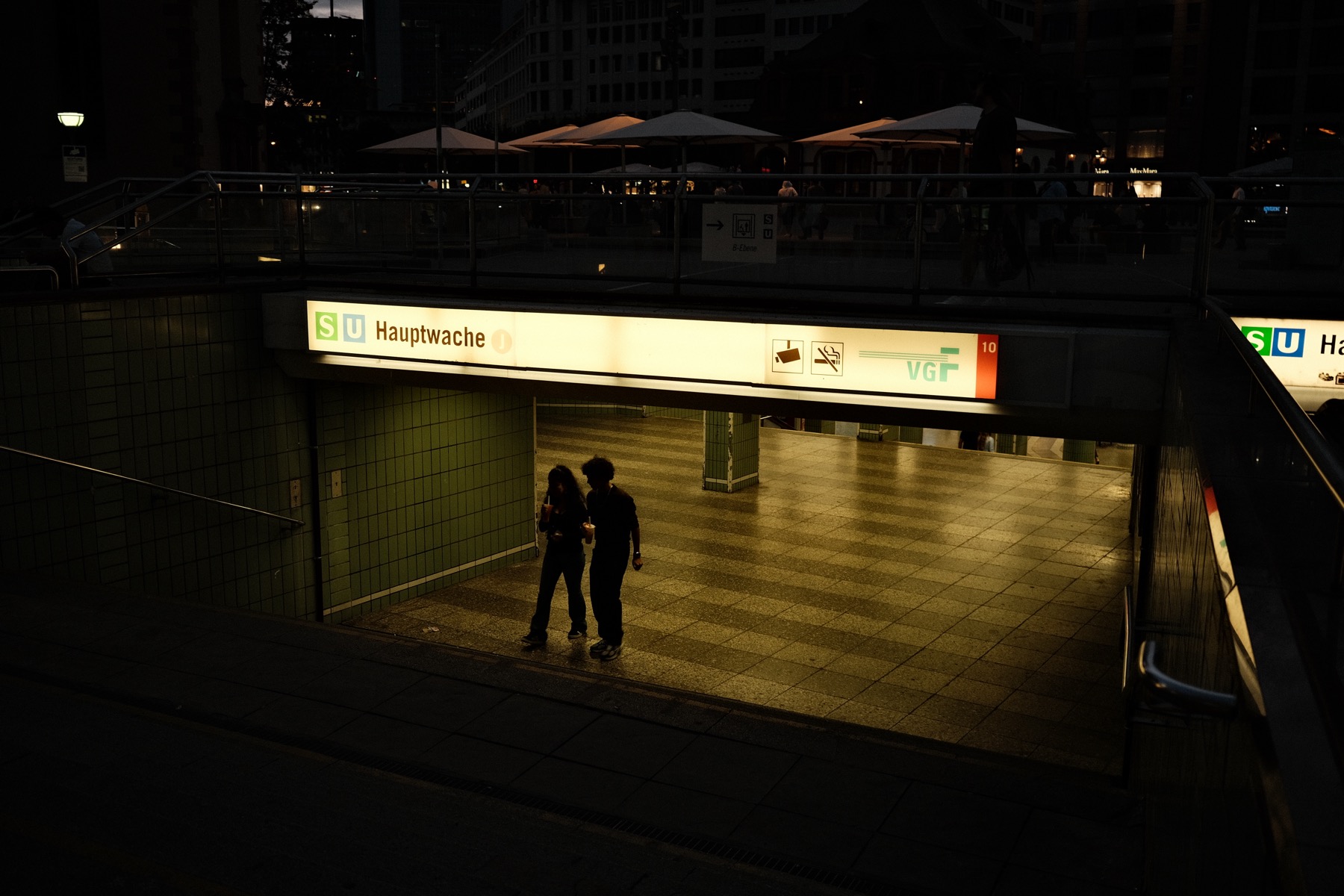
<p>There is no real story behind this one. I fell in love with the light of the Hauptwache station: the green tiles, the glowing sign, the floor that looks wet even when it is not. I took a handful of shots from different angles, trying to get the camera to see it the way I did. Then a couple walked into the frame, and in some way I feel like they completed it. I do not know them, and they will never know that they are in my favourite photograph of the station. Somehow the empty version of the shot was missing something, and they supplied it.</p>

<h2 id="what-stayed">What stayed</h2>

<p>Looking at the photos together, I notice that they are arranged by distance. A living room, a view from above, a façade, a distant bridge, a ceiling, and finally, small and in silhouette, two people. I did not plan any of it. I went to Frankfurt for work and expected to take photographs only when the work allowed.</p>

<p>What I took away is that a big city rewards looking. It does not hand you its frames, and you have to be willing to stop, look up, and turn around. I am grateful that I got to live in this one long enough to do so.</p>

<p>The photos I chose here kind of reflect what I think about Frankfurt. A cacophonic city. A mix of cement and glass, but also the natural river. A mix of modernity, but also romantic architecture. A mix of noise, but also silence.</p>

<p>There are more frames on my hard drive, and perhaps some of them will find their way here another day.</p>

<p>Until next time!</p>

<div class="footnotes" role="doc-endnotes">
  <ol>
    <li id="fn:1">
      <p>A nickname that combines “Main,” the river, with “Manhattan,” on account of the skyline. <a href="#fnref:1" class="reversefootnote" role="doc-backlink">&#8617;</a></p>
    </li>
    <li id="fn:2">
      <p>Pfungstadt is a small town south of Frankfurt, in the state of Hesse. <a href="#fnref:2" class="reversefootnote" role="doc-backlink">&#8617;</a></p>
    </li>
    <li id="fn:DB">
      <p>It is kind of a running joke that Deutsche Bahn trains are always late or with problems. I will be honest and say that I do not feel like it was that bad, but maybe I got lucky. <a href="#fnref:DB" class="reversefootnote" role="doc-backlink">&#8617;</a></p>
    </li>
  </ol>
</div>]]></content><author><name>Andrea Esposito</name></author><category term="Photography" /><category term="photography" /><category term="frankfurt" /><category term="street photography" /><category term="architecture" /><category term="black and white" /><category term="germany" /><category term="fujifilm" /><summary type="html"><![CDATA[Most people only pass through Frankfurt. I lived there for the length of a research project, and these are the photographs I like best from that time.]]></summary><media:thumbnail xmlns:media="http://search.yahoo.com/mrss/" url="https://espositoandrea.github.io/assets/images/photography/2026-03-frankfurt-skyline.jpg" /><media:content medium="image" url="https://espositoandrea.github.io/assets/images/photography/2026-03-frankfurt-skyline.jpg" xmlns:media="http://search.yahoo.com/mrss/" /></entry><entry><title type="html">On Doom-Scrolling and Brain Fog as Escaping Mechanisms</title><link href="https://espositoandrea.github.io/blog/posts/2026/09/on-doom-scrolling-and-brain-fog.html" rel="alternate" type="text/html" title="On Doom-Scrolling and Brain Fog as Escaping Mechanisms" /><published>2026-09-19T00:00:00+00:00</published><updated>2026-09-19T00:00:00+00:00</updated><id>https://espositoandrea.github.io/blog/posts/2026/09/on-doom-scrolling-and-brain-fog</id><content type="html" xml:base="https://espositoandrea.github.io/blog/posts/2026/09/on-doom-scrolling-and-brain-fog.html"><![CDATA[<p>Sometimes you have to admit that you have lost. Everyone sometimes loses a battle, even the best generals of the past did. It happens. It’s not important. What counts is that you do not lose the war. To that end, one must analyze the lost battle closely, to understand the reasons for their loss, identify mistakes, and recognize patterns—this will leave you prepared for the next battle, so that you have more chances of winning.</p>

<p>In the last days, I’ve lost the battle against <em>doom-scrolling</em> (or, more generally, against a slight dopamine addiction). In this brief column, I try to process what happened so that I may be stronger next time.</p>

<p>As almost everyone in this generation, I struggle with what is generally called “<em>doom-scrolling</em>:” I spend an embarrassing amount of time neck-bent and eyes-fixed on my iPhone screen, consuming content—mostly short-form Instagram Reels, although sometimes the loop is broken by the infinite scroll in search for a longer YouTube video (that usually ends up in me absent-mindedly watching some useless video of questionable novelty).</p>

<p>Although this is still a problem in itself, the issue is not really with the obscene amount of time I waste in consuming trash (or “slop”), but rather with how I feel at the end of it. On the web<sup id="fnref:1"><a href="#fn:1" class="footnote" rel="footnote" role="doc-noteref">1</a></sup>, I have seen people call it in a way that perfectly describes the feeling: <em>brain fog</em>.</p>

<p>I am a computer science researcher—not for reasons of money (I currently work in an Italian public university, where salaries are notoriously low), but because I love the job. I like having ideas or insights, formulating hypotheses, testing them, and writing about the whole process to share it and its results. In my free time, instead, I like writing (pieces just like this) and photography. You can easily see how detrimental “brain fog” is to my life: it genuinely prevents me from exploring my own creativity, not only affecting my free time (and my sanity), but also heavily affecting my work life and, as such, my living means. In fact, no creativity means no ideas; no ideas means no new research; no new research means no funding and, ultimately, no job.</p>

<p>As many of us do, I have set up a whole lot of apps, limits, and routines to prevent doom-scrolling and the subsequent brain fog. Whichever YouTube video on the subject you name, I probably watched it. Everything was working fine (although not perfectly). Until last week.</p>

<p>I was in Germany<sup id="fnref:2"><a href="#fn:2" class="footnote" rel="footnote" role="doc-noteref">2</a></sup> for work. My girlfriend decided to join me on her journey back to Spain, where she works. Everything has been going smoothly. Until she had to leave to get to her flight. A surge of some kind of bittersweet sadness and solitude got hold of me as soon as I went back to my apartment after saying goodbye. And then, there I was—scrolling indefinitely in the vain hope of drowning the uncomfortable feelings.</p>

<p>Now we get to the pattern. I started thinking, and I noticed something: doom-scrolling provided an easy way out every time I was feeling bad, down, or alone. It was not really the letting time slip away, nor the easy dopamine fix that I was searching for. It was the same brain fog that I have been trying to avoid.</p>

<p>The reasoning is as simple as it is rotten: if there is enough fog, I will be numb enough to not <em>feel</em>. This is exactly as bad as it sounds: it’s nothing at all different from an alcoholic who drinks heavily because they are depressed or want to escape the issues of their own life<sup id="fnref:3"><a href="#fn:3" class="footnote" rel="footnote" role="doc-noteref">3</a></sup>.</p>

<p>Let’s now move to the conclusion of this column. I apologize to anyone who was expecting a solution—this post is not at all similar to the ones of the <em>gurus</em> who have found the way to fix doom-scrolling and reduce their screen time to a tenth. Although recognizing a pattern is the first step in solving the underlying issue, I am still far from being able to provide guidance.</p>

<p>What I can say is simple and possibly trivial. Do not beat yourself up too badly for failing: your willpower won’t suffice when you are not at your best. Similarly, every containment system only holds if we do not actively want to circumvent it. However, being aware of your unconscious behavior and tendencies will help when—numbed by your feelings, hoping to escape them—you autonomously walk towards slipping into the same behaviors you want to avoid.</p>

<p>Until next time!</p>
<div class="footnotes" role="doc-endnotes">
  <ol>
    <li id="fn:1">
      <p>I do not really recall a precise source, nor the “first appearance” of the word. <a href="#fnref:1" class="reversefootnote" role="doc-backlink">&#8617;</a></p>
    </li>
    <li id="fn:2">
      <p>For the curious readers, I was in Walldorf (Mörfelden-Walldorf), near Frankfurt am Main. <a href="#fnref:2" class="reversefootnote" role="doc-backlink">&#8617;</a></p>
    </li>
    <li id="fn:3">
      <p>This is an over-simplification of alcoholism as a dependency—and I apologize for this. However, it is just an example to help better drive my description. <a href="#fnref:3" class="reversefootnote" role="doc-backlink">&#8617;</a></p>
    </li>
  </ol>
</div>]]></content><author><name>Andrea Esposito</name></author><category term="Personal Columns" /><summary type="html"><![CDATA[Sometimes you have to admit that you have lost. Everyone sometimes loses a battle. In the last days, I've lost the battle against doom-scrolling. In this brief column, I try to process what happened.]]></summary><media:thumbnail xmlns:media="http://search.yahoo.com/mrss/" url="https://images.unsplash.com/photo-1743184437508-f1b3b793922b?crop=entropy&amp;cs=tinysrgb&amp;fit=max&amp;fm=jpg&amp;ixid=M3wzMDAzMzh8MHwxfHNlYXJjaHw0fHxzY3JvbGxpbmd8ZW58MHx8fHwxNzg5NzU2MzAxfDA&amp;ixlib=rb-4.1.0&amp;q=80&amp;w=1080" /><media:content medium="image" url="https://images.unsplash.com/photo-1743184437508-f1b3b793922b?crop=entropy&amp;cs=tinysrgb&amp;fit=max&amp;fm=jpg&amp;ixid=M3wzMDAzMzh8MHwxfHNlYXJjaHw0fHxzY3JvbGxpbmd8ZW58MHx8fHwxNzg5NzU2MzAxfDA&amp;ixlib=rb-4.1.0&amp;q=80&amp;w=1080" xmlns:media="http://search.yahoo.com/mrss/" /></entry><entry><title type="html">On Compendiums and General Notebooks Usage</title><link href="https://espositoandrea.github.io/blog/posts/2025/10/on-compendiums-and-general-notebooks-usage.html" rel="alternate" type="text/html" title="On Compendiums and General Notebooks Usage" /><published>2025-10-04T13:46:00+00:00</published><updated>2025-10-04T13:46:00+00:00</updated><id>https://espositoandrea.github.io/blog/posts/2025/10/on-compendiums-and-general-notebooks-usage</id><content type="html" xml:base="https://espositoandrea.github.io/blog/posts/2025/10/on-compendiums-and-general-notebooks-usage.html"><![CDATA[<p>I am now learning the difference between a “compendium” and other types of notebooks (in particular, commonplace books). Yet, I am here wondering: Is all of this structure really necessary?</p>

<p>I am hating myself nowadays for wasting so much time on social media. I am continuously consuming videos—let them be “shorts” or typical long-form videos. I could be productive. I could learn something for real. I could reason, get new ideas, and be creative. Yet, I am wasting time learning the difference between the words that could be used to describe a simple notebook.</p>

<p>I am wondering whether this makes sense for two main reasons. The first one is, obviously, due to the fact that I am “wasting” rather than “spending” my time watching this kind of videos. The other one is actually related to its content: is it <em>actually</em> needed? Or is the only thing that matters about a notebook the fact that, in a way, you use it to reason or to jot down ideas, thoughts, and references?</p>

<p>What will I think of this in the future? Only time will tell…</p>

<p>Until next time,</p>]]></content><author><name>Andrea Esposito</name></author><category term="Letters" /><summary type="html"><![CDATA[I am now learning the difference between a “compendium” and other types of notebooks (in particular, commonplace books). Yet, I am here wondering: Is all of this structure really necessary?]]></summary><media:thumbnail xmlns:media="http://search.yahoo.com/mrss/" url="https://espositoandrea.github.io/assets/images/banners/on-compendiums-and-general-notebooks-usage.jpg" /><media:content medium="image" url="https://espositoandrea.github.io/assets/images/banners/on-compendiums-and-general-notebooks-usage.jpg" xmlns:media="http://search.yahoo.com/mrss/" /></entry><entry><title type="html">My struggle with boredom in an uninteresting city</title><link href="https://espositoandrea.github.io/blog/posts/2025/09/my-struggle-with-boredom-in-an-uninteresting-city.html" rel="alternate" type="text/html" title="My struggle with boredom in an uninteresting city" /><published>2025-09-07T00:00:00+00:00</published><updated>2025-09-07T00:00:00+00:00</updated><id>https://espositoandrea.github.io/blog/posts/2025/09/my-struggle-with-boredom-in-an-uninteresting-city</id><content type="html" xml:base="https://espositoandrea.github.io/blog/posts/2025/09/my-struggle-with-boredom-in-an-uninteresting-city.html"><![CDATA[<p>This post resembles a rant more than an actual blog post; thus, I doubt that you
will gain anything from reading this. However, I feel like I must share these
thoughts in the hope of exorcising these sensations and, possibly, elicit a
solution.</p>

<p>I live in the periphery of a relatively small town. Therefore, the overall
landscape is not as vivid and full of life as it is in the bigger cities. While
this is somewhat of a blessing most of the time (e.g., less traffic, less
crowds, less overzealous businesses that raise their prices as it happens in
more touristy areas), it easily gets boring.</p>

<p>Perhaps my brain is just used to the constant stimulation provided by social
media, and perhaps my expectations are too high, as I am used to seeing a lot of
people going around in bigger cities with a ton of things to do and see.
However, I cannot help but feel bored when I am trying to spend some time here,
and I cannot help but feel so unmotivated to do anything that I often end up
doing nothing at all.</p>

<p>I genuinely <em>love</em> photography. It is one of my passions,
alongside stationery and writing. So, one may ask, “Why don’t you spend some
time practicing photography by going around in your city and shooting some
street or architectural photos?”</p>

<p>Well… This clashes with another issue of being in the same city in which you
were born and spent most of your life: you
take <em>everything</em> for granted. And as much as one can tell
themselves “I must overcome this,” it is always easier said than done, as it is
quite difficult to combat something subconscious on which you have little to no
control.</p>

<p>And this is the reason for this post: <em>I am bored</em>. As such, I turn
to something I like that allows me to deal with my boredom and helps in the
search for a solution, while also exorcising these bad
feelings: <em>writing</em>.</p>

<p>However, this blog post also serves another purpose: to justify a little bit of
additional exploration in the way this blog is organized. I would like to
leverage this platform to explore new interests, to try and see the same city
under a new light, and to explore new genres of photography—different from those
I am used to.</p>

<p>I hope that you, as a reader, will appreciate these new efforts that will
inevitably create new kinds of content. I also hope that you choose to chime in
by suggesting the ways <em>you</em> deal with boredom and with an uninteresting and
uninspiring environment.</p>

<p>So… How do <em>you</em> deal with boredom in an uninteresting
city?</p>

<p>Until next time!</p>]]></content><author><name>Andrea Esposito</name></author><category term="Personal Columns" /><category term="writing" /><category term="journal" /><category term="rant" /><category term="boredom" /><summary type="html"><![CDATA[This post resembles a rant more than an actual blog post; thus, I doubt that you will gain anything from reading this. However, I feel like I must share these thoughts in the hope of exorcising these sensations and, possibly, elicit a solution.]]></summary><media:thumbnail xmlns:media="http://search.yahoo.com/mrss/" url="https://www.researchinink.com/wp-content/uploads/2025/09/0iT2UVjDo_7g7AFUQ.webp" /><media:content medium="image" url="https://www.researchinink.com/wp-content/uploads/2025/09/0iT2UVjDo_7g7AFUQ.webp" xmlns:media="http://search.yahoo.com/mrss/" /></entry><entry><title type="html">I recently got a typewriter in an attempt to regain my focus</title><link href="https://espositoandrea.github.io/blog/posts/2025/08/typewriter.html" rel="alternate" type="text/html" title="I recently got a typewriter in an attempt to regain my focus" /><published>2025-08-30T00:00:00+00:00</published><updated>2025-08-30T00:00:00+00:00</updated><id>https://espositoandrea.github.io/blog/posts/2025/08/typewriter</id><content type="html" xml:base="https://espositoandrea.github.io/blog/posts/2025/08/typewriter.html"><![CDATA[<p>My mind and general interests are currently in a very hard spot. I am a
Computer Science researcher. This brings me face-to-face with technology every
day. And I do that with immense pleasure: I love keeping updated on the latest
tech news and gadgets. I usually follow, every year, at least Apple’s WWDC, in
an attempt to understand where the software I use every day is moving to. And I
feel genuine excitement about any new announcement they make. As an example,
working in the field of Human-Computer Interaction, I was genuinely thrilled
when Apple introduced the “Dynamic Island” because, in a way, it was blurring
the line between hardware and software.</p>

<p>Every new gadget, tool, app, software, and whatnot sparks my curiosity. I
<em>must</em> try them all.</p>

<p>However, this sort of “maximalism” when it comes to the tools I use every day
for my work is not something that is actually useful, but rather almost
harmful.</p>

<p>I usually struggle with an astonishingly easy-to-distract brain. Therefore, the
sheer amount of tools is a perfectly fertile ground to get my mind out of the
zone and start trying new stuff out. Some days, I happen to not be able to do
any actual work at all, but rather I spend the entire time trying out new
stuff, or customizing (which I justify as “improving”) already-known tools.</p>

<p>Obviously, this is a serious hazard for my productivity on its own, but the
effects are amplified by the usual digital distractions: messages, e-mails, MS
Teams calls, calendar invites, social media… A nightmare full of inputs for my
already lazy and easily distracted brain…</p>

<p>Now, being a researcher means that a great deal of my time is spent on writing
stuff. Whether it is a report, a paper, some documentation, bureaucratic forms,
or whatever else, I am writing. So, I need a way to improve my focus and get
myself in flow for writing.</p>

<p>Here enters my grandad. During a routine clean-up of his garage, he found an
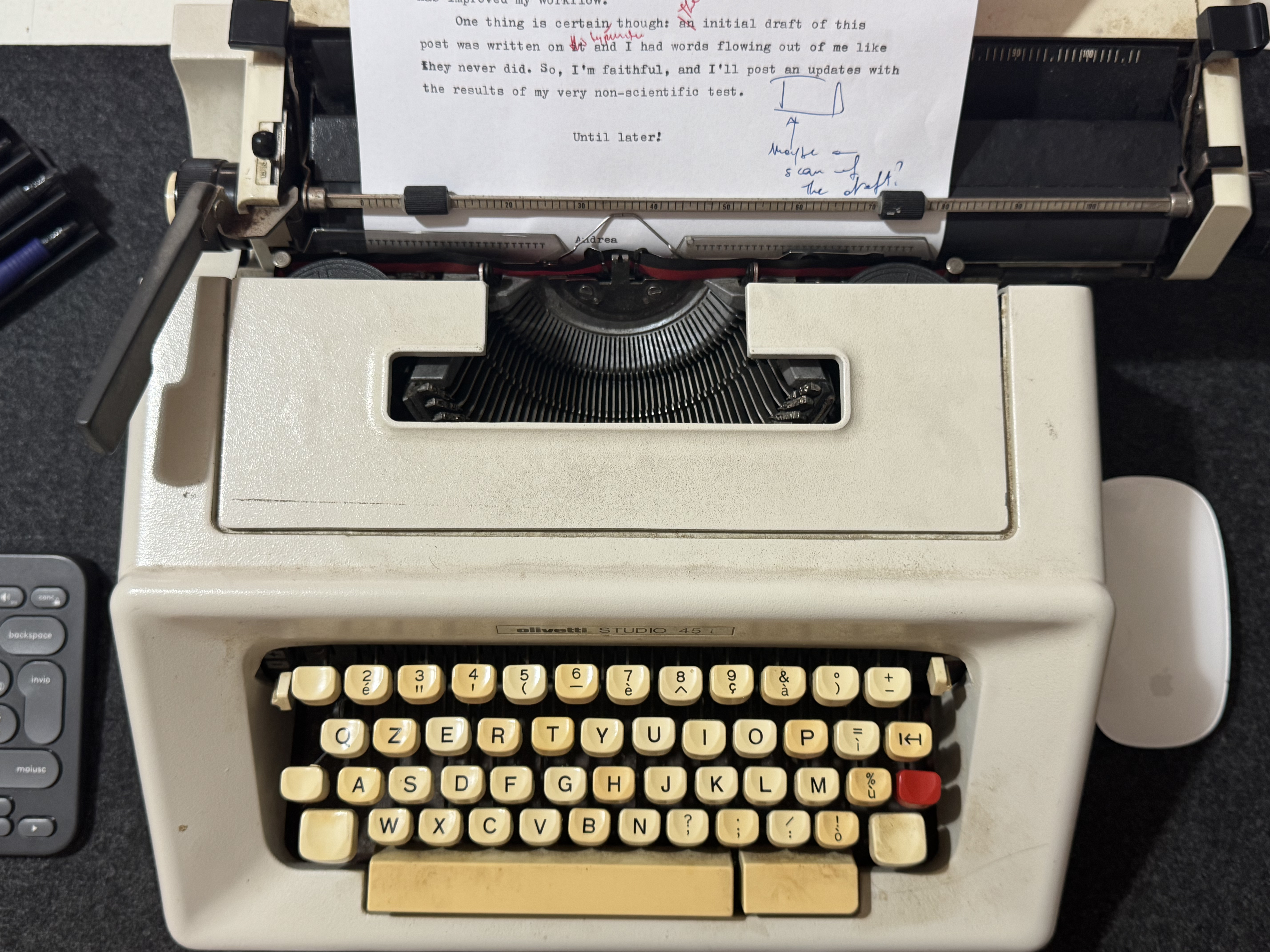
old typewriter that he had: an old <em>Olivetti Studio 45 i</em>. Before he threw it
away, I got an idea: why not try using it to reach my goal of distraction-free
in-the-zone writing?</p>

<figure>
<img src="/assets/images/typewriter.jpg" class="img-fluid" />
<figcaption>The typewriter</figcaption>
</figure>

<p>I wouldn’t be the first one using a typewriter in 2025 for the purpose of
typing drafts of text: a quick search on YouTbube or Googls surfaces enough
results to help me not feeling stupid for even having had this idea.</p>

<p><em>Did it work?</em> I currently have no idea. In theory, it should: using a
typewriter lets you have absolutely no form of distractions (unless someone
comes tapping on your shoulder, clearly), and having a material piece of paper
with writing on it is a plus since it makes reviewing your text a far more
pleasurable experience (at least for me, since I prefer reading on paper).
However, I have not had this typewriter for enough time to understand whether
it has improved my workflow.</p>

<p>One thing is certain, though: the initial draft of this post was written on
this typewriter, and I had words flowing out of me like they never did. So, I’m
faithful, and I’ll post updates with the results of my very non-scientific
test.</p>

<p><a href="/assets/pdfs/typewriter-draft.pdf" target="_blank">See the original draft here!</a></p>

<p>Until later!</p>]]></content><author><name>Andrea Esposito</name></author><category term="writing" /><category term="typewriter" /><category term="distraction" /><category term="experiment" /><category term="focus" /><summary type="html"><![CDATA[My mind and general interests are currently in a very hard spot. I am a Computer Science researcher. This brings me face-to-face with technology every day. And I do that with immense pleasure: I love keeping updated on the latest tech news and gadgets. I usually follow, every year, at least Apple’s WWDC, in an attempt to understand where the software I use every day is moving to. And I feel genuine excitement about any new announcement they make. As an example, working in the field of Human-Computer Interaction, I was genuinely thrilled when Apple introduced the “Dynamic Island” because, in a way, it was blurring the line between hardware and software.]]></summary><media:thumbnail xmlns:media="http://search.yahoo.com/mrss/" url="https://espositoandrea.github.io/assets/images/typewriter.jpg" /><media:content medium="image" url="https://espositoandrea.github.io/assets/images/typewriter.jpg" xmlns:media="http://search.yahoo.com/mrss/" /></entry><entry><title type="html">The Power of Handwriting: Embracing Slowness in a Digital World</title><link href="https://espositoandrea.github.io/blog/posts/2025/08/power-of-handwriting.html" rel="alternate" type="text/html" title="The Power of Handwriting: Embracing Slowness in a Digital World" /><published>2025-08-23T15:16:20+00:00</published><updated>2025-08-23T15:16:20+00:00</updated><id>https://espositoandrea.github.io/blog/posts/2025/08/power-of-handwriting</id><content type="html" xml:base="https://espositoandrea.github.io/blog/posts/2025/08/power-of-handwriting.html"><![CDATA[<p>In a world of endless tabs, blinking cursors, and distraction-driven design, writing on paper feels like a deliberate act of resistance. It’s <em>slow</em>. It’s tactile. It offers no shortcuts, no notifications, and no undo button. And yet, as a researcher, I find myself turning to pen and paper more and more often, especially when I need to think.</p>

<p>If you are interested, subscribe so you won’t miss a single post!</p>

<p>The slowness of handwriting is often viewed as a limitation, especially in tech-centric environments where speed is a virtue. But for me, that very slowness is its greatest gift. When I write by hand, I have to choose my words more carefully. I become aware of the shape of my thoughts, not just their content. Ideas don’t just appear—they unfold. They wander. They breathe.</p>

<figure>
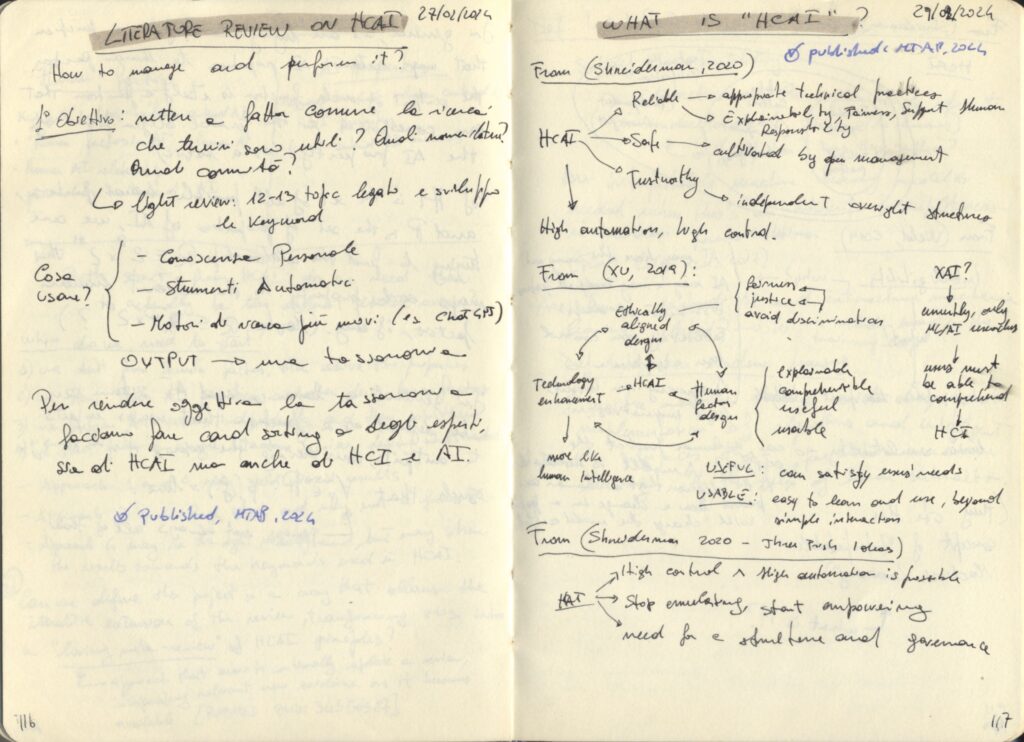
  <img src="/assets/images/posts/power-of-handwriting/scan-1-small.jpeg" alt="A scan of two pages taken from my &quot;Research Notebook&quot;, showing a mix of prose, lists, and diagrams." />
  <figcaption>A scan of two pages taken from my "Research Notebook", showing a mix of prose, lists, and diagrams.</figcaption>
</figure>

<p>Handwriting your thoughts lets you be free to place them on the page however you like. You do not have to follow strict guidelines, you do not have a structure, and you do not have limited support for a specific format. You can do whatever you want with your pen. For example, in this scan from my research notebook (a cheap Moleskine knockoff), I mixed prose, lists, and diagrams effortlessly. By refining what was written on these pages, I was able to write an open-access article published in <a href="https://doi.org/10.1007/s11042-024-20414-5" target="_blank" rel="noopener noreferrer">Multimedia Tools and Applications</a>.</p>

<p>There is also a kind of humility in writing by hand. You make mistakes. You cross things out. You can’t effortlessly delete an entire paragraph and start over. The page becomes a record of your thinking, with all its false starts and messy in-betweens. And that messiness matters. Research isn’t linear. Neither is thinking. The analog page embraces that.</p>

<p>Some of my (self-declared) best ideas have started in the margins of a notebook, not in a LaTeX editor or a collaborative document. My research questions often emerge not from formal planning, but from doodles, mind maps, or quick fragments of sentences scribbled on scrap paper. I use my fountain pen not because it’s fancy, but because it slows me down just enough to hear myself think, and it is smooth enough to avoid shifting my focus to it scratching on the paper. An example is this additional scan from my research notebook shown here, which resulted in another open-access article published in <a href="https://doi.org/10.1038/s41598-024-59616-0" target="_blank" rel="noopener noreferrer">Scientific Reports</a>.</p>

<figure>
  <img src="/assets/images/posts/power-of-handwriting/scan-2-small.jpeg" alt="A scan of a page taken from my &quot;Research Notebook&quot;, showing early drafts of a possible data visualization for an AI system." />
  <figcaption>A scan of a page taken from my "Research Notebook", showing early drafts of a possible data visualization for an AI system.</figcaption>
</figure>

<p>Of course, paper is not perfect. Eventually, I digitize, I draft in markdown, I code, and I collaborate online. But those are <em>later stages</em>. The beginning—the unfiltered and uncertain beginning—still belongs to paper.</p>

<p>I write on paper because it gives me space to not know. It allows thoughts to simmer instead of sprint. I understood that thinking and creativity are not races, and the best insights often arrive when I stop trying to be efficient.</p>

<p>So, no: handwriting hasn’t become obsolete in my workflow. It has become <em>essential</em>.</p>

<p>And maybe, in choosing slowness over speed, paper over screen, I’m not just holding onto an old habit… I’m protecting my way of thinking that the digital world keeps trying to optimize out of existence.</p>

<h2 id="a-small-note-bringing-slowness-to-my-digital-workflow">A Small Note: Bringing Slowness to My Digital Workflow</h2>

<p>As a small and quick note, I want to touch on how I am trying to bring the slowness of paper to my digital workflow. In the last period, I have been trying to write mostly in plain text. I do this in two different ways:</p>

<ol>
  <li>At an initial stage, when my writing is still in a rough draft, I use just plain text to avoid any kind of distraction from styling. Do we actually need to wonder whether a section of text should be in bold, in italic, or in other formats? For this reason, if I use this workflow, at this point in time I only use <em>plain text</em>—not even <a href="https://en.wikipedia.org/wiki/Markdown" target="_blank" rel="noopener noreferrer">Markdown</a>. Basically, my computer becomes a glorified typewriter (as a confession, I wanted to try buying and working on a typewriter, but sooner or later we have to face the fact that we live in a digital world that needs all documents in digital, and I am too lazy to just rewrite everything).</li>
  <li>I try to use distraction-free editors. In this latest period, perhaps out of habit from my system admin days, I use <a href="https://www.vim.org" target="_blank" rel="noopener noreferrer">Vim</a>. This allows me to write with <em>nothing</em> on the screen other than my text (sometimes I employ the <a href="https://github.com/junegunn/goyo.vim" target="_blank" rel="noopener noreferrer">Gojo plugin</a> for this purpose). I full-screen the editor and I <em>just write</em>.</li>
</ol>

<p>If you are interested, subscribe so you won’t miss a single post!</p>

<h2 id="a-disclaimer">A Disclaimer</h2>

<p>This blog post does not aim to be a guide or to attack digitalization. I am a computer scientist: my job exists <em>thanks to</em> digitalization. This blog post just wants to present how I cope with my general lack of attention and my tendency to search for distractions, while being creative and productive, while still “feeling good” while accomplishing a task.</p>]]></content><author><name>Andrea Esposito</name></author><category term="Thoughts" /><category term="creativity" /><category term="handwriting" /><category term="ideas" /><category term="process" /><category term="writing" /><summary type="html"><![CDATA[In a world of endless tabs, blinking cursors, and distraction-driven design, writing on paper feels like a deliberate act of resistance. It’s slow. It’s tactile. It offers no shortcuts, no notifications, and no undo button. And yet, as a researcher, I find myself turning to pen and paper more and more often, especially when I need to think.]]></summary><media:thumbnail xmlns:media="http://search.yahoo.com/mrss/" url="https://espositoandrea.github.io/assets/images/posts/power-of-handwriting/banner.png" /><media:content medium="image" url="https://espositoandrea.github.io/assets/images/posts/power-of-handwriting/banner.png" xmlns:media="http://search.yahoo.com/mrss/" /></entry><entry><title type="html">Blending the Personal and the Professional: On Writing on a Blog as a Researcher</title><link href="https://espositoandrea.github.io/blog/posts/2025/06/blending-the-personal-and-the-professional-on-writing-on-a-blog-as-a-researcher.html" rel="alternate" type="text/html" title="Blending the Personal and the Professional: On Writing on a Blog as a Researcher" /><published>2025-06-09T16:20:58+00:00</published><updated>2025-06-09T16:20:58+00:00</updated><id>https://espositoandrea.github.io/blog/posts/2025/06/blending-the-personal-and-the-professional-on-writing-on-a-blog-as-a-researcher</id><content type="html" xml:base="https://espositoandrea.github.io/blog/posts/2025/06/blending-the-personal-and-the-professional-on-writing-on-a-blog-as-a-researcher.html"><![CDATA[<p>There is something strangely intimate about writing a blog post as a researcher. It is not a paper, a deliverable, or a grant proposal. It doesn’t carry the armor to criticism that peer review somewhat provides, and it feels strange to hit that “post” button without receiving the green light from other co-authors. It is, in a way, closer to a journal entry. And <em>that’s where the lines begin to blur</em>.</p>

<p>Doing research, especially in Italy, is not just a job. For better or for worse, research becomes an identity. And that identity spills into every aspect of life. There are no real work hours for early-career researchers here (nor for full professors, although with some exceptions). No well-defined boundaries. You read a paper during lunch, you sketch out a prototype at 11 PM, you answer emails on Sunday… Not because you have to (well, <em>sometimes</em> you do), but because the work is always with you: in your mind, in your values, in your ambitions. And pressure and expectations also play their role. Passion and pressure are deeply intertwined.</p>

<p>And so, when I sit down to write a post for this blog, I find myself wondering: who am I writing as? A researcher? As a curious person who loves pens and notebooks as much as he loves researching AI? As someone who needs a creative outlet to let their own thoughts loose? The answer is: all of them. Writing here acknowledges that I am not split into two separate souls.</p>

<p>In academia, we often aim to compartmentalize: keep your work separate from your life, your thoughts from your feelings, your objectivity from your subjectivity. But the reality is more complicated, and in my experience, more human. I think better when I don’t pretend to be a machine.</p>

<p>The truth is, the personal and professional lives are not just blended: they are sometimes indistinguishable. Especially in the kind of research I do, centered on people and their interaction with intelligent systems. To understand what it means to build a human-centered AI, you need to be fully human yourself.</p>

<p>So this blog is not a distraction from my academic work. It is an extension of it. A slower, more reflective, more personal kind of thinking. A place where I can use words like “feel,” “wonder,” and “hope” without citation. A space where the pace of writing is not dictated by deadlines, but by curiosity.</p>

<p>And perhaps, in sharing these thoughts publicly, I’m not just writing for myself. I’m writing for other researchers who feel the same dissonance. Who want to embrace their whole selves, not just their academic title. Who are tired of pretending there is a clear line between their life and their research.</p>

<p>There isn’t. And that’s okay, <em>as long as it doesn’t drive you to insanity</em>.</p>]]></content><author><name>Andrea Esposito</name></author><category term="Thoughts" /><summary type="html"><![CDATA[There is something strangely intimate about writing a blog post as a researcher. It is not a paper, a deliverable, or a grant proposal. It doesn’t carry the armor to criticism that peer review somewhat provides, and it feels strange to hit that “post” button without receiving the green light from other co-authors. It is, in a way, closer to a journal entry. And that’s where the lines begin to blur.]]></summary><media:thumbnail xmlns:media="http://search.yahoo.com/mrss/" url="https://espositoandrea.github.io/assets/images/banners/blending-the-personal-and-the-professional-on-writing-on-a-blog-as-a-researcher.jpg" /><media:content medium="image" url="https://espositoandrea.github.io/assets/images/banners/blending-the-personal-and-the-professional-on-writing-on-a-blog-as-a-researcher.jpg" xmlns:media="http://search.yahoo.com/mrss/" /></entry><entry><title type="html">Beyond Automation, Toward Symbiosis: Interactions Between Humans and Artificial Intelligence</title><link href="https://espositoandrea.github.io/blog/posts/2024/11/beyond-automation.html" rel="alternate" type="text/html" title="Beyond Automation, Toward Symbiosis: Interactions Between Humans and Artificial Intelligence" /><published>2024-11-26T00:00:00+00:00</published><updated>2024-11-26T00:00:00+00:00</updated><id>https://espositoandrea.github.io/blog/posts/2024/11/beyond-automation</id><content type="html" xml:base="https://espositoandrea.github.io/blog/posts/2024/11/beyond-automation.html"><![CDATA[<h2 id="introduction-human-ai-interaction">Introduction: Human-AI Interaction</h2>

<p>We are now living in an era where artificial intelligence (commonly known as AI) is no longer a distant concept confined to research laboratories or science fiction books. Instead, it has become a reality that intertwines with our daily lives (albeit, at times, not without issues<sup id="fnref:1"><a href="#fn:1" class="footnote" rel="footnote" role="doc-noteref">1</a></sup>). We interact with AI systems daily, often without even realizing it: from voice assistants that respond to our requests to recommendations from our favorite streaming platforms about which TV series to watch when we’re bored on the couch. And here lies the first warning sign: AI is no longer just an observer learning from our behaviors but is starting to influence them.</p>

<p>These interactions between humans and AI go beyond merely using technology; they touch deeply on aspects of our identity, our relationships, and the decisions we make every day. These connections can provide help and support but also bring various risks and challenges, such as the loss of skills, commonly referred to in research as “deskilling.”<a class="citation" href="#sambasivan2022deskilling">[1]</a> The growing presence of AI in society raises complex questions: How do we want to relate to it? What role do we want to assign it in our lives? And how ready are we to trust decisions that, in some sense, are not entirely our own?</p>

<p>In this article, we will briefly explore these questions, aiming to prompt readers to reflect on what it might mean to interact with AI.</p>

<h2 id="types-of-interaction-with-artificial-intelligence">Types of Interaction with Artificial Intelligence</h2>

<p>AI has become an invisible companion in our daily activities, enabling various services we use every day in a wide range of ways and sectors, from entertainment to healthcare, through different modes of interaction.</p>

<p>Undoubtedly, the most successful mode of interaction with AI in this particular period is that of chatbots and voice assistants, more generally referred to as “conversational agents,” such as the modern <a href="https://chatgpt.com/" target="_blank">ChatGPT</a> or the more familiar <a href="https://www.apple.com/it/siri/" target="_blank">Siri</a> and <a href="https://developer.amazon.com/it-IT/alexa" target="_blank">Alexa</a>. This type of interaction is also used by various “assistants” found on the websites of telecom providers and other companies, offering initial support to their customers.</p>

<p>To better understand the different modes of interaction between humans and AI, it is useful to consider some theoretical models that analyze levels of automation. These models provide an interesting perspective on how technology can automate various tasks while varying the degree of human involvement and control.</p>

<figure>
<img src="https://miro.medium.com/v2/resize:fit:1400/format:webp/0*5GEGeRzU74tokTKt.png" class="img-fluid" />
<figcaption>One-dimensional model of automation</figcaption>
</figure>

<p>One of the earliest models of automation, and also one of the most frequently cited, defines a one-dimensional scale of task automation levels.<a class="citation" href="#parasuraman2000model">[2]</a> This model, based on 10 levels, has two extremes: total human control (a level where the machine provides no support or automation for the specific task) and total automation (a level where the human has no role in performing the task, not even as a supervisor).</p>

<figure>
<img src="https://miro.medium.com/v2/resize:fit:1400/format:webp/0*f8Tekhw7NhrNnxky.png" class="img-fluid" />
<figcaption>New two-dimensional model of automation</figcaption>
</figure>

<p>A more recent model, on the other hand, separates the degree of automation from the level of human control, offering a two-dimensional view of the relationship between humans and AI (or, more generally, machines).<a class="citation" href="#shneiderman2020human">[3]</a> This approach allows for the identification of four types of systems:</p>

<ol>
  <li>Non-automated, with high human control: systems based on the user’s skill (e.g., a piano).</li>
  <li>Fully automated, with minimal human control: entirely managed by the machine (e.g., car airbags).</li>
  <li>Low automation, with low human control: for example, a watch.</li>
  <li>Highly automated, with high human control: for example, an automatic camera that allows the user to adjust its settings.</li>
</ol>

<p>This last category represents the ideal for AI systems, as it ensures reliability, safety, and trust.</p>

<p>It is interesting to note, however, that systems can sometimes be overly controlled by the user or <em>excessively</em> automated. These are cases where AI-based systems lead users to rely too heavily on them, potentially resulting in accidents, even fatal ones<sup id="fnref:5"><a href="#fn:5" class="footnote" rel="footnote" role="doc-noteref">2</a></sup>.</p>

<h2 id="the-approach-recommended-by-research">The Approach Recommended by Research</h2>

<p>In this context, several researchers have sought to validate the theories presented in the two-dimensional model of human-AI interaction. A particularly intriguing question arises: <em>is automation truly the best way to leverage AI?</em></p>

<p>To explore this, Italian researchers (including the author of this note) investigated various ways to design artificial intelligence in the specific application context of evaluating the usability (a quality dimension) of web pages.<a class="citation" href="#esposito2024fine">[4]</a> The results are particularly thought-provoking: the analysis showed that a fully automated approach was highly effective at identifying webpage issues, especially the most severe ones. This highlights the remarkable efficiency and accuracy of AI when applied to specific tasks.</p>

<p>However, the most intriguing insight emerged when exploring alternative approaches aimed at <em>enhancing</em> human capabilities rather than replacing them through task automation. By combining the refined judgment of human experts with the analytical capabilities of AI, researchers discovered a “synergy” that significantly improves the detection of lower-severity issues. This hybrid approach leverages the strengths of both humans and machines, enabling the identification of subtle problems that would otherwise elude an analysis performed solely by automation or humans alone.</p>

<p>This finding suggests that, while automation excels at identifying more obvious problems, integrating human expertise with AI can create a more comprehensive evaluation process. Thus, the choice of the right way to interact with AI is closely tied to the specific <em>needs</em> and <em>tasks</em> of end users — that is, us!</p>

<h2 id="a-possible-future-a-symbiosis-between-humans-and-ai">A Possible Future: A Symbiosis Between Humans and AI</h2>

<p>AI is becoming increasingly present in our lives, promising numerous improvements but also exposing us to various risks. Throughout this article, we explored different levels of interaction between humans and AI, highlighting how the integration of human expertise and AI capabilities enables more comprehensive and precise outcomes, even capturing subtle details. The discovery of the potential of this “<em>symbiosis</em>” between humans and AI points to a promising model for the future: not automation that replaces humans, but AI that <em>collaborates</em> with us, <em>amplifying</em> our potential.</p>

<figure>
<img src="https://miro.medium.com/v2/resize:fit:1400/format:webp/0*SaIJsq6-ZqL5hM6o.png" class="img-fluid" />
<figcaption>Image generated using AI (GPT-4o)</figcaption>
</figure>

<p>This “symbiotic” relationship between humans and AI goes beyond mere efficiency. It represents a model that combines human sensitivity and awareness with the analytical power of machines. AI can precisely solve significant and repetitive problems, but it is often humans, with their intuition and judgment, who can perceive nuances and complexities that an automated system cannot grasp on its own. This balance between autonomy and assistance gives us the opportunity to design a future in which AI and humanity collaborate to achieve results that neither could accomplish alone. In conclusion, the true value of AI will emerge not just from its technical capabilities, but from the quality of the relationship we build with it.</p>

<h2 id="references">References</h2>

<ol class="bibliography"><li><span class="reference"><span id="sambasivan2022deskilling"><div class="csl-left-margin">[1]</div><div class="csl-right-inline">Nithya Sambasivan and Rajesh Veeraraghavan. 2022. The Deskilling of Domain Expertise in AI Development. In <i>CHI Conference on Human Factors in Computing Systems</i> (CHI ’22), ACM, New Orleans, LA, USA, 1–14. DOI:https://doi.org/10.1145/3491102.3517578</div></span></span>
</li>
<li><span class="reference"><span id="parasuraman2000model"><div class="csl-left-margin">[2]</div><div class="csl-right-inline">R. Parasuraman, T. B. Sheridan, and C. D. Wickens. 2000. A Model for Types and Levels of Human Interaction with Automation. <i>IEEE Transactions on Systems, Man, and Cybernetics – Part A: Systems and Humans</i> 30, 3 (May 2000), 286–297. DOI:https://doi.org/10.1109/3468.844354</div></span></span>
</li>
<li><span class="reference"><span id="shneiderman2020human"><div class="csl-left-margin">[3]</div><div class="csl-right-inline">Ben Shneiderman. 2020. Human-Centered Artificial Intelligence: Reliable, Safe &amp; Trustworthy. <i>International Journal of Human–Computer Interaction</i> 36, 6 (March 2020), 495–504. DOI:https://doi.org/10.1080/10447318.2020.1741118</div></span></span>
</li>
<li><span class="reference"><span id="esposito2024fine"><div class="csl-left-margin">[4]</div><div class="csl-right-inline">Andrea Esposito, Giuseppe Desolda, and Rosa Lanzilotti. 2024. The Fine Line between Automation and Augmentation in Website Usability Evaluation. <i>Scientific Reports</i> 14, 1 (May 2024), 10129. DOI:https://doi.org/10.1038/s41598-024-59616-0</div></span></span>
</li></ol>

<hr />

<p><em>This post originally appeared (in Italian) in <a href="https://magia.news/" target="_blank">MagIA</a>. Read the original post <a href="https://magia.news/oltre-lautomazione-verso-una-simbiosi-le-interazioni-tra-esseri-umani-e-intelligenza-artificiale/" target="_blank">here</a>.</em></p>

<div class="footnotes" role="doc-endnotes">
  <ol>
    <li id="fn:1">
      <p>For example, one can refer to the various cases of accidents caused by autonomous vehicles: <a href="https://www.theguardian.com/technology/2024/apr/26/tesla-autopilot-fatal-crash" target="_blank">https://www.theguardian.com/technology/2024/apr/26/tesla-autopilot-fatal-crash</a> <a href="#fnref:1" class="reversefootnote" role="doc-backlink">&#8617;</a></p>
    </li>
    <li id="fn:5">
      <p>See the various cases of accidents caused by autonomous vehicles mentioned earlier: <a href="https://www.theguardian.com/technology/2024/apr/26/tesla-autopilot-fatal-crash" target="_blank">https://www.theguardian.com/technology/2024/apr/26/tesla-autopilot-fatal-crash</a> <a href="#fnref:5" class="reversefootnote" role="doc-backlink">&#8617;</a></p>
    </li>
  </ol>
</div>]]></content><author><name>Andrea Esposito</name></author><category term="artificial intelligence" /><category term="symbiosis" /><category term="enhancement" /><category term="interaction" /><summary type="html"><![CDATA[We are now living in an era where artificial intelligence (commonly known as AI) is no longer a distant concept confined to research laboratories or science fiction books. Instead, it has become a reality that intertwines with our daily lives (albeit, at times, not without issues¹). We interact with AI systems daily, often without even realizing it: from voice assistants that respond to our requests to recommendations from our favorite streaming platforms about which TV series to watch when we're bored on the couch. And here lies the first warning sign: AI is no longer just an observer learning from our behaviors but is starting to influence them.]]></summary><media:thumbnail xmlns:media="http://search.yahoo.com/mrss/" url="https://miro.medium.com/v2/resize:fit:3584/format:webp/1*LKZUNIiJXPUk_TKmBocZMw.png" /><media:content medium="image" url="https://miro.medium.com/v2/resize:fit:3584/format:webp/1*LKZUNIiJXPUk_TKmBocZMw.png" xmlns:media="http://search.yahoo.com/mrss/" /></entry><entry><title type="html">Is automation really the best use of AI?</title><link href="https://espositoandrea.github.io/blog/posts/2024/07/is-automation-really-the-best-use-of-ai.html" rel="alternate" type="text/html" title="Is automation really the best use of AI?" /><published>2024-07-30T00:00:00+00:00</published><updated>2024-07-30T00:00:00+00:00</updated><id>https://espositoandrea.github.io/blog/posts/2024/07/is-automation-really-the-best-use-of-ai</id><content type="html" xml:base="https://espositoandrea.github.io/blog/posts/2024/07/is-automation-really-the-best-use-of-ai.html"><![CDATA[<p>Artificial Intelligence (AI) has somewhat become an integral part of our daily lives. From the moment we wake up to when we go to bed, the chances of crossing AI are high. AI is everywhere, almost becoming a <em>buzzword</em>. From AI-powered virtual assistants (like Amazon’s Alexa, Google Assistant, and Apple’s Siri), helping us manage our schedules or control smart home devices, up to AI-enabled cars, as modern vehicles are equipped with AI for navigation and other driver-assistance systems. Even in day-to-day life, we interface with AI: think about recommender systems on your favourite streaming platforms or even just the text prediction of your smartphone’s keyboard.</p>

<figure>
<img src="/assets/images/posts/medium/0I1l3o7xdWaQIrMm5.jpg" alt="" class="img-fluid" />
<figcaption>We interface with AI everyday. For example, it is used to power the recommendation system of your favorite online streaming services. Photo by <a href="https://unsplash.com/@cardmapr?utm_source=medium&amp;utm_medium=referral" target="_blank" rel="noopener noreferrer">CardMapr.nl</a> on <a href="https://unsplash.com?utm_source=medium&amp;utm_medium=referral" target="_blank" rel="noopener noreferrer">Unsplash</a></figcaption>
</figure>

<p>What do all of these systems have in common?</p>

<p>Most AI systems follow a simple trend: they are designed with the goal of <em>automating as many tasks as possible</em>. This automation aims to increase <em>efficiency</em>, <em>reduce human error</em>, and <em>save time</em> for more complex and creative activities. However, this approach often raises questions about its effectiveness and the broader implications (like deskilling or job displacement).</p>

<p>But one question arises: <em>is automation really the best way we can use AI?</em></p>

<figure>
<img src="/assets/images/posts/medium/0mYKOtI_6ZFHj74xW.jpg" alt="" class="img-fluid" />
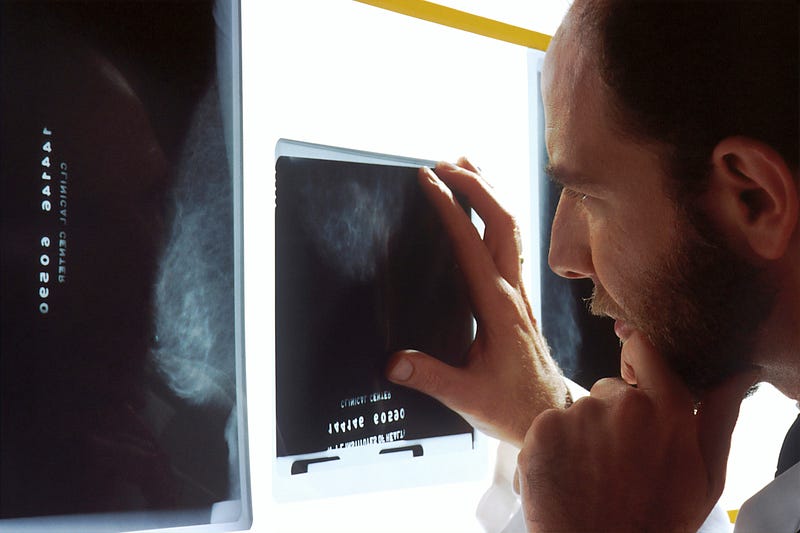
<figcaption>A lot of jobs are at risk of being replaced by Artificial Intelligence. An example is <a href="https://hms.harvard.edu/news/does-ai-help-or-hurt-human-radiologists-performance-depends-doctor" target="_blank" rel="noopener noreferrer">radiology</a>. However, the question should be: “is <em>replacing</em> human vision in radiology actually the best thing we could do for people?” Photo by <a href="https://unsplash.com/@nci?utm_source=medium&amp;utm_medium=referral" target="_blank" rel="noopener noreferrer">National Cancer Institute</a> on <a href="https://unsplash.com?utm_source=medium&amp;utm_medium=referral" target="_blank" rel="noopener noreferrer">Unsplash</a></figcaption>
</figure>

<p><a href="https://doi.org/10.1038/s41598-024-59616-0" target="_blank" rel="noopener noreferrer">Recent research</a> aimed to explore this question, analysing AI’s effectiveness in applications beyond simple automation. This study provides insights into how AI can be leveraged to enhance human capabilities rather than replace human effort. The results show that the choice ultimately depends on what users want to do with AI: we should remember that we’re humans designing AI for humans, so humans are the ones who know what they’ll be using it for!</p>

<h3 id="the-research">The Research</h3>

<p>In the study conducted by the <a href="https://ivu.di.uniba.it" target="_blank" rel="noopener noreferrer">Interaction, Visualization, Usability &amp; UX Laboratory</a> of the <a href="https://uniba.it" target="_blank" rel="noopener noreferrer">University of Bari</a>, 99 participants were recruited to understand how their perception and performance varied while using AI. Three different strategies were explored: pure automation, pure augmentation (a strategy in which humans have all control), and a middle-ground solution.</p>

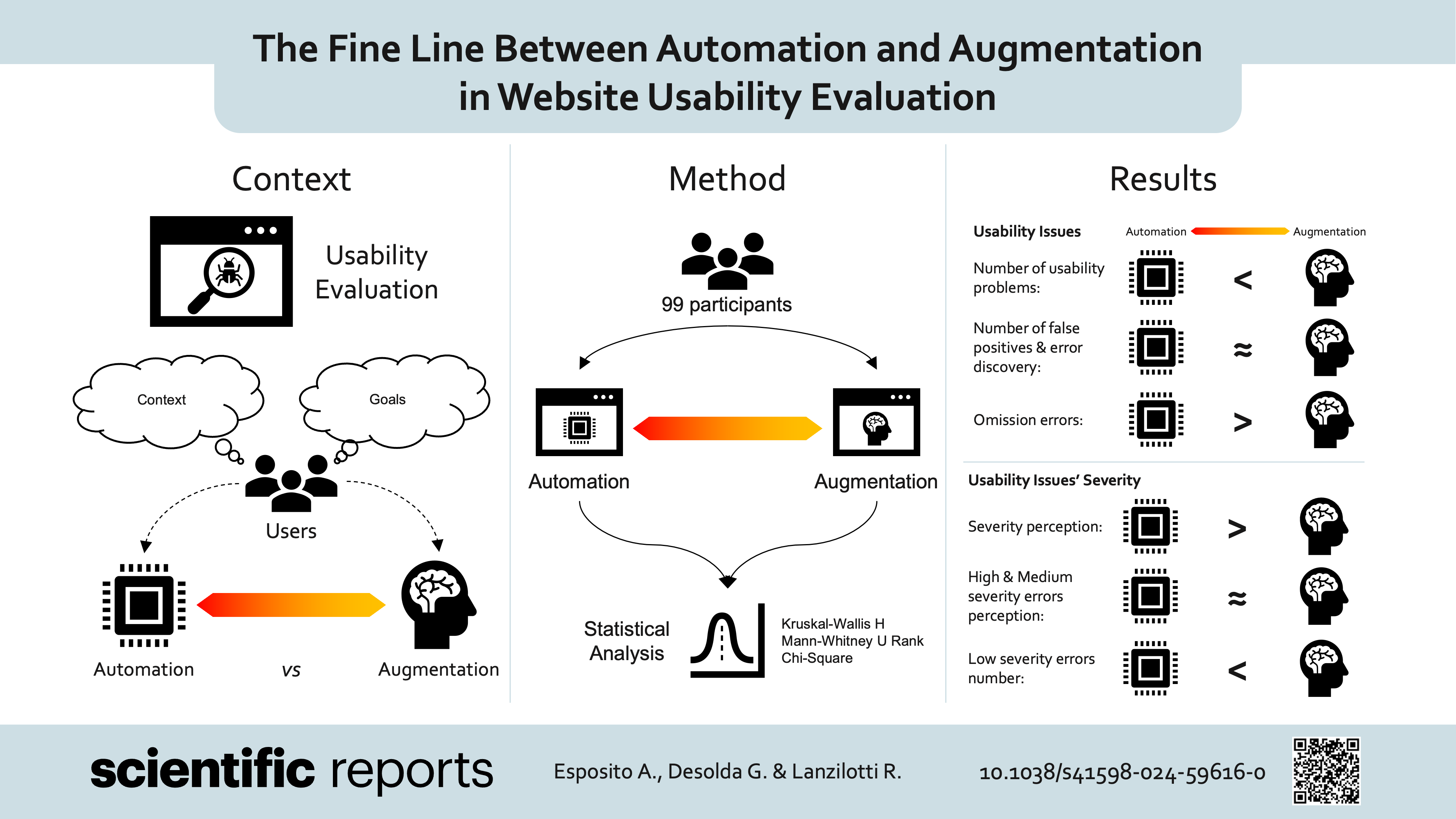
<figure>
<img src="/assets/images/posts/scirep-serene/visual-abstract.png" alt="" class="img-fluid" />
<figcaption>Graphical abstract of the research article. Image by the <a href="https://medium.com/ai-advances/to-automate-or-to-augment-humans-c3f805d35d55" target="_blank" rel="noopener noreferrer">paper’s authors</a>.</figcaption>
</figure>

<p>The study was conducted in the context of user experience and usability evaluation. Using an AI system that is able to detect users’ emotions starting from the way they use their mouse, the AI system associates “negative” emotions with usability and user experience problems (a designer should then solve them).</p>

<p>The results show that users perceive its output completely differently by varying how AI is designed. For instance, when using an AI designed following the “automation” approach, users could grasp the severity of the identified issues quickly, but they identified fewer issues overall. On the contrary, while using the “augmentation” approach, users were able to detect more issues. Thus, they were more “powerful”, but their severity perception was not as good. The middle-ground solution was similar to the augmentation solution, suggesting that it could be able to provide “the best of both worlds.”</p>

<h3 id="key-takeaways">Key Takeaways</h3>

<figure>
<img src="/assets/images/posts/medium/1cJCRVb13QI7RLNGUZ-F9Uw.png" alt="" class="img-fluid" />
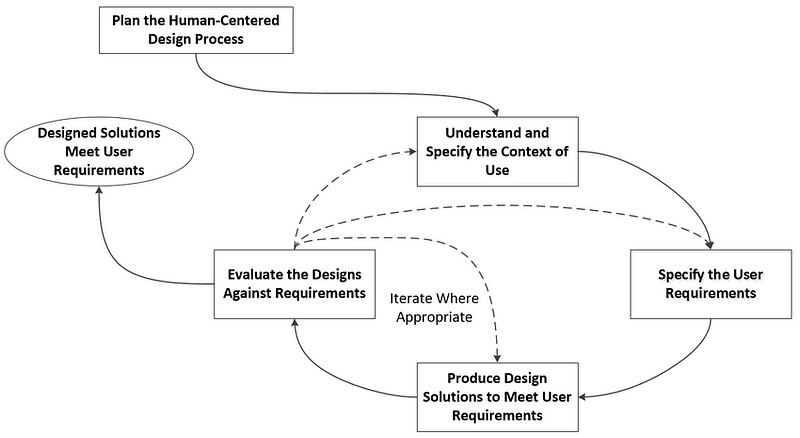
<figcaption>Human-Centred Design has been around for decades. It is used to create better software, that satisfies our needs. So why should it be different for AI? Diagram by the <a href="http://dx.doi.org/10.2196/humanfactors.5443" target="_blank" rel="noopener noreferrer">authors of a research paper</a>.</figcaption>
</figure>

<p>As already discussed, humans are the ones for which AI systems are built. We should not forget that. Thus, following a “human-centred” approach to AI design is important. We should ask our users: “What will you do with this AI?” Their answer should then drive the design, tipping the scale towards “automation” or “augmentation” approaches.</p>

<p>As with all research, it should be noted that we do not know if the results provided are easily generalizable. Only future research will confirm or disband this. However, there are decades of research on “classical” software (without AI), and a human-centred approach is always needed. Just search for “human-centred design” on Google or Google Scholar, if you want proof.</p>

<p>Thus, one can easily conclude that following this approach is a <strong>safe bet</strong>. And a bet that doesn’t really cost that much: how difficult is it to ask a sample of your user, “What do you really need?”</p>]]></content><author><name>Andrea Esposito</name></author><summary type="html"><![CDATA[Research shows it isn’t… but it depends on users’ goals.]]></summary><media:thumbnail xmlns:media="http://search.yahoo.com/mrss/" url="https://espositoandrea.github.io/assets/images/posts/medium/0pLRNICnSOCFgaydu.jpg" /><media:content medium="image" url="https://espositoandrea.github.io/assets/images/posts/medium/0pLRNICnSOCFgaydu.jpg" xmlns:media="http://search.yahoo.com/mrss/" /></entry><entry><title type="html">How to design AI for empowering humans</title><link href="https://espositoandrea.github.io/blog/posts/2024/06/how-to-design-ai-for-empowering-humans.html" rel="alternate" type="text/html" title="How to design AI for empowering humans" /><published>2024-06-30T00:00:00+00:00</published><updated>2024-06-30T00:00:00+00:00</updated><id>https://espositoandrea.github.io/blog/posts/2024/06/how-to-design-ai-for-empowering-humans</id><content type="html" xml:base="https://espositoandrea.github.io/blog/posts/2024/06/how-to-design-ai-for-empowering-humans.html"><![CDATA[<p>Nowadays, Artificial Intelligence has permeated into almost every aspects of society. Even governmental and religious leaders are now discussing the impact that this technology have and will continue to have on our life. From tailored recommendations on streaming or shopping platforms, to virtual assistants, AI’s presence is ubiquitous. Although AI proves to be extremely useful, <strong>fear and distrust</strong> still linger: discussion on ethics, creativity, and many other aspects is still lively both in academia and in the greater society. Perhaps the more prevalent worry is that <strong>AI may, one day, replace us</strong> — both in our jobs and in our creative outlets. This fear stems from the approach and goals used until today while designing AI: the one of automation.</p>

<p>However, the true potential of AI lies not just in <em>automating</em> tasks, but in <em>augmenting</em> human capabilities, thus empowering us to achieve more. Designing AI with this new focus means creating systems that <strong>enhance our abilities</strong> rather than replacing them.</p>

<p>This approach is strongly advocated by Prof. Ben Shneiderman, who published a seminal book on the topic.<a class="citation" href="#shneiderman2022human">[1]</a> Human-Centred AI — the name of this new approach — involves thoughtful consideration of how AI can <strong>complement human skills</strong>, support us, and enhance productivity, without hindering our autonomy and creativity. This is not dissimilar to what Human-Computer Interaction and (more precisely) Interaction/UX Design do with “classical” software.</p>

<p>In this blog post, we will explore some insights from my recent <strong>research paper</strong>, published in <a href="https://www.nature.com/srep/" target="_blank" rel="noopener noreferrer">Nature Scientific Reports</a>: “The Fine Line Between Automation and Augmentation in Website Usability Evaluation.”<a class="citation" href="#esposito2024fine">[2]</a> More precisely, we will analyze the delicate balance between using AI to automate processes and using it to augment human capabilities, highlighting how knowing the users goals is crucial for AI — exactly how Interaction/UX design proved it to be crucial for classical software. The research paper is open access (thus, completely free) and can be found at the following link.</p>

<p><em>Let’s dive into it, but first here’s a quick visual abstract of our paper as a TL;DR!</em></p>

<figure>
<img src="/assets/images/posts/scirep-serene/visual-abstract.png" alt="A visual abstract for the manuscript titled “The fine line between automation and augmentation in website usability evaluation.” It feature the title of the paper on top, while the journal logo, authors, and DOI are at the bottom. The main section is subdivided in three columns, titled (from left to right) “Context”, “Method”, and “Results”. The content of each column is described in the main text of the article." />
<figcaption>Visual abstract of the paper. Image by the author.</figcaption>
</figure>

<h2 id="the-role-of-ai-in-modern-technology">The Role of AI in Modern Technology</h2>

<p>The journey of AI started in a <a href="https://home.dartmouth.edu/about/artificial-intelligence-ai-coined-dartmouth" target="_blank" rel="noopener noreferrer">1956 workshop in Dartmouth</a>, of which John McCarty was one of the main promoters. Since then, AI has always been an interesting field for research. Initial applications were mostly on problem solving or games (e.g., chess). However, in the following decades, also thanks to the massive increase in available and affordable computational power, AI saw an increase in power and capabilities. Nowadays, <a href="https://www.politico.com/news/2024/02/04/how-ai-is-quietly-changing-everyday-life-00138341" target="_blank" rel="noopener noreferrer">AI is everywhere</a> and has become an end-user product: starting from intelligent assistants on our smartphones, recommender systems for shopping or streaming, and other applications, it is impossible to think to go by a single day without interacting at least one form of AI — unless you choose to go completely “off the grid.”</p>

<p>Despite its ubiquitous presence, it’s crucial to distinguish between two key paradigms in AI: <em>automation and augmentation</em>. <strong>Automation</strong> involves using AI to perform tasks <strong>without</strong> human intervention. This can lead to increased efficiency and cost savings but rises concerns about the risk job displacement and a reliance on technology at the expense of human skills.</p>

<p><strong>Augmentation</strong>, on the other hand, emphasizes using AI to <strong>enhance</strong> human capabilities. Thus, rather than replacing humans, augmented AI acts as a “collaborative partner,” providing insights, suggestions, and support to help people make better decisions and perform tasks more effectively. This approach maintains the central role of human judgment and creativity while leveraging the computational power and data analysis capabilities of AI.</p>

<p>By focusing on augmentation, we can design AI systems that empower users, making them more productive and enabling them to achieve things previously thought impossible. This balance between automation and augmentation is a critical theme in designing AI that truly benefits society, and it is the foundation of the insights presented in my research on website usability evaluation.</p>

<h2 id="a-brief-summary-of-the-research">A Brief Summary of the Research</h2>

<p>In my latest research effort, as part of the <a href="https://ivu.di.uniba.it" target="_blank" rel="noopener noreferrer">IVU Laboratory in Bari</a>, we set out to explore the way automation and approaches change the way AI systems are perceived. This was done by involving the same subjects that would be greatly impacted by an AI system: its end users. More precisely, we focused on the context of <a href="https://www.nngroup.com/articles/usability-testing-101/" target="_blank" rel="noopener noreferrer">usability evaluation</a>.</p>

<p>In previous work,<a class="citation" href="#desolda2021detecting">[3]</a> we had implemented an AI system that is able to detect emotions by analyzing the way users interact with a web page (i.e., by analyzing their mouse movements and keyboard use — while also ensuring privacy). Based on such model, we constructed a survey where emotion values were shown to usability evaluators.</p>

<p>Furthermore, we identified usability and UX issues connected to the emotion values. These issues are also shown to the evaluators, alongside the emotion values, as if it was part of the output of the AI model (similar to what happens in a Wizard of Oz study).</p>

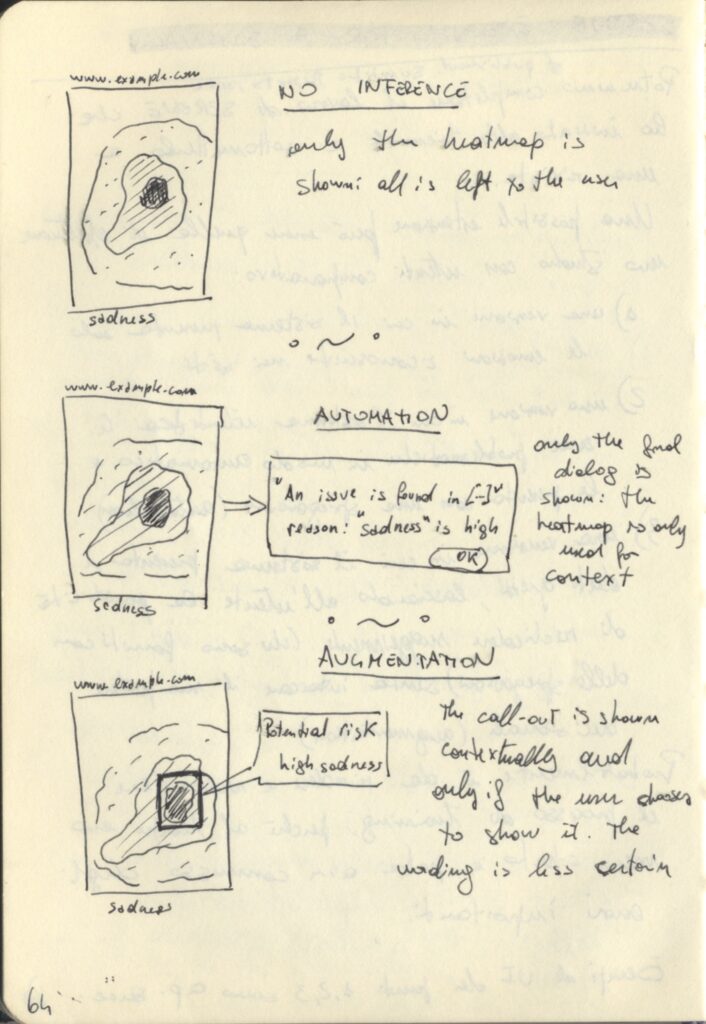
<p>In showing the emotion values and the connected issues, we varied the “automation level,” meaning that we simulated the adoption of either an automation or an augmentation approach. The way the output was presented to evaluators is shown in the next image.</p>

<figure>
  <img src="/assets/images/posts/scirep-serene/automation-modalities.png" alt="The different levels of automation/augmentation implemented in SERENE to help discover usability problems: a) a list of the usability problems; b) a heatmap showing the concentration of the emotions overlapped to the webpage; c) the heatmap of the previous visualization also extended with purple rectangles highlighting potential usability problems. Image by the author and extracted from the paper." />
  <figcaption>The different levels of automation/augmentation implemented in SERENE to help discover usability problems: a) a list of the usability problems; b) a heatmap showing the concentration of the emotions overlapped to the webpage; c) the heatmap of the previous visualization also extended with purple rectangles highlighting potential usability problems. Image by the author and extracted from the paper.</figcaption>
</figure>

<p>The data collection phase involved a total of 99 usability evaluators, and each of them interacted with only one of the automation levels. The results were then analyzed statistically through the use of custom metrics defined to evaluate the amount of usability issues found and the errors made by the evaluators.</p>

<h2 id="automation-vs-augmentation-a-delicate-balance">Automation vs. Augmentation: A Delicate Balance</h2>

<p>The findings of our research were both revealing and thought-provoking. In fact, our analysis showed that a <strong>fully automated</strong> approach was <strong>highly effective</strong> at pinpointing <strong>major usability issues</strong>, especially those categorized as medium to high severity. This highlights the remarkable efficiency and precision of AI when applied to specific tasks within usability evaluation.</p>

<p>However, the most fascinating insight emerged from exploring <strong>augmented</strong> approaches. By combining the nuanced judgment of human experts with the analytical capabilities of AI, we uncovered a <strong>synergy</strong> that significantly enhanced the detection of <strong>low-severity usability issues</strong>. This hybrid approach capitalized on the strengths of both human and machine, allowing the identification of subtle problems that might otherwise be overlooked by either automation or humans alone.</p>

<p>This discovery suggests that while automation excels in efficiently handling more straightforward, higher-impact usability problems, the integration of human expertise with AI can create a more comprehensive evaluation process. Ultimately, the choice of the right automation level highly <strong>depends</strong> on the specific <strong>needs and tasks</strong> of your end-users. For example, if efficiency is key, an automated approach may be preferred. On the contrary, if the goal is discovering smaller issues and perfecting the details, an augmented approach must be preferred.</p>

<h2 id="conclusion-and-practical-tips">Conclusion and Practical Tips</h2>

<p>In conclusion, our research shows that efforts should not be put in choosing between humans and machines, but rather on creating a seamless integration of both — almost through a <strong>symbiotic relationship</strong>. The Human-Centered AI framework demonstrates how combining human decision-making and expertise with AI capabilities can yield superior results.</p>

<p>Ultimately, our research highlights the need to embrace the symbiotic relationship between humans and AI, while maintaining a focus on <strong>human-centered design</strong> principles. This approach ensures that the requirements and goals of the system are aligned with <strong>human needs</strong>, striking the right <strong>balance</strong> between automation and augmentation. By doing so, we can achieve more comprehensive and effective usability evaluations, benefiting from the best of both worlds.</p>

<p>To conclude this story, I want to share a <strong>practical tip</strong>, stemmed from what I learned from this research. Before embarking on an AI creation journey, take the time to thoroughly understand what your users actually need. Conduct user research to gather insights into their requirements and preferences. This will help you determine the appropriate level of automation and ensure that the AI system you develop truly enhances their experience. By aligning the AI’s capabilities with user needs, you can create more effective and user-friendly solutions.</p>

<h2 id="references">References</h2>

<ol class="bibliography"><li><span class="reference"><span id="shneiderman2022human"><div class="csl-left-margin">[1]</div><div class="csl-right-inline">Ben Shneiderman. 2022. <i>Human-Centered AI</i>. Oxford University Press, Oxford. DOI:https://doi.org/10.1093/oso/9780192845290.001.0001</div></span></span>
</li>
<li><span class="reference"><span id="esposito2024fine"><div class="csl-left-margin">[2]</div><div class="csl-right-inline">Andrea Esposito, Giuseppe Desolda, and Rosa Lanzilotti. 2024. The Fine Line between Automation and Augmentation in Website Usability Evaluation. <i>Scientific Reports</i> 14, 1 (May 2024), 10129. DOI:https://doi.org/10.1038/s41598-024-59616-0</div></span></span>
</li>
<li><span class="reference"><span id="desolda2021detecting"><div class="csl-left-margin">[3]</div><div class="csl-right-inline">Giuseppe Desolda, Andrea Esposito, Rosa Lanzilotti, and Maria F. Costabile. 2021. Detecting Emotions Through Machine Learning for Automatic UX Evaluation. In <i>Human-Computer Interaction – INTERACT 2021</i>, Carmelo Ardito, Rosa Lanzilotti, Alessio Malizia, Helen Petrie, Antonio Piccinno, Giuseppe Desolda and Kori Inkpen (eds.). Springer International Publishing, Cham, 270–279. DOI:https://doi.org/10.1007/978-3-030-85613-7_19</div></span></span>
</li></ol>]]></content><author><name>Andrea Esposito</name></author><summary type="html"><![CDATA[Balancing automation and human expertise when designing AI requires understanding your users’ needs.]]></summary><media:thumbnail xmlns:media="http://search.yahoo.com/mrss/" url="https://espositoandrea.github.io/assets/images/posts/medium/1WeqMmn78Dd9e8SZSE-Va1g.jpeg" /><media:content medium="image" url="https://espositoandrea.github.io/assets/images/posts/medium/1WeqMmn78Dd9e8SZSE-Va1g.jpeg" xmlns:media="http://search.yahoo.com/mrss/" /></entry></feed>